A railway station can be an excellent location for a hotel business because it brings a steady flow of passengers, tourists, business travellers, families and people who need short-term accommodation.
Not every traveller needs a luxury hotel. Many passengers look for budget rooms, short stays, clean accommodation, family rooms and convenient access to the railway station. This creates opportunities for hotels, guest houses, hostels, lodges and serviced accommodation near busy railway stations.
There is also a distinction between a private hotel near a railway station and accommodation operated within railway premises. IRCTC manages railway retiring rooms at major stations, while private hotels near stations operate as normal hospitality businesses subject to applicable local regulations. IRCTC’s current tourism platform also offers hotel booking and retiring-room services.
Quick Information
| Factor | Details |
| Business Type | Hotel, lodge, guest house, hostel or serviced stay |
| Main Customers | Railway passengers, tourists, business travellers |
| Best Location | Near busy railway stations |
| Popular Segment | Budget and mid-range accommodation |
| Main Advantage | Regular passenger traffic |
| Main Challenge | Competition and operating costs |
| Revenue Sources | Rooms, food, laundry and other services |
| Important Requirements | Property, registrations, licences and local approvals |
| Business Model | Independent hotel, franchise or managed property |
Why Start a Hotel Near a Railway Station?
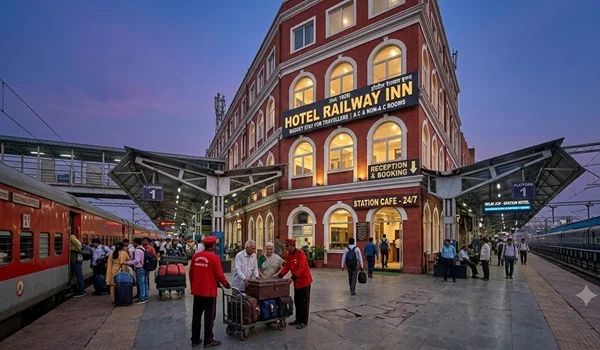
The biggest advantage is convenience.
Passengers arriving late at night, leaving early in the morning or waiting for another train often prefer accommodation close to the station.
A hotel near a railway station can target:
- Train passengers
- Families
- Tourists
- Business travellers
- Students
- Railway employees and visitors
- Passengers with train connections
- People visiting nearby hospitals or markets
- Guests attending local events
A busy railway station can therefore provide a wider customer base than a hotel located in a less connected area.
- Budget Hotel Near Railway Station
A budget hotel is one of the most practical models for this market.
Passengers often prioritise:
- Clean rooms
- Safe surroundings
- Attached bathrooms
- Air conditioning or fans
- Wi-Fi
- Hot water
- 24-hour reception
- Easy station access
The focus is on value rather than luxury.
A small property with well-maintained rooms can compete effectively if it offers a convenient location and reliable service.
- Short-Stay Hotel
Railway passengers do not always require a full night’s stay.
Some may need a room for:
- A few hours
- Daytime rest
- Train connections
- Early morning departures
- Late-night arrivals
This creates an opportunity for short-stay accommodation where legally permitted and where the property’s operating model supports it.
Railway retiring rooms themselves demonstrate the demand for transit accommodation. IRCTC says retiring rooms are available in single, double and dormitory formats, with facilities varying by station.
- Family Hotel
Families travelling by train often prefer hotels with larger rooms and convenient facilities.
A family-focused hotel can offer:
- Family rooms
- Extra beds
- Attached bathrooms
- Breakfast
- Luggage storage
- Lift access
- Safe parking
- 24-hour assistance
This model can work particularly well in tourist and pilgrimage cities.
- Business Hotel
Railway stations are also important for business travellers.
A business-oriented hotel can target people visiting a city for:
- Meetings
- Conferences
- Trade activities
- Government work
- Business appointments
- Short work trips
Useful facilities can include:
- Fast Wi-Fi
- Work desk
- Breakfast
- Printing facilities
- Airport or station transfer
- Flexible check-in options
- Hotel Near a Tourist Railway Station
Tourist destinations can provide another strong opportunity.
Stations located near popular tourist attractions may receive travellers throughout the year.
For example, hotels near railway stations serving major tourism destinations can target both domestic and international visitors.
Additional services can include:
- Local sightseeing
- Taxi arrangements
- Tour packages
- Guide services
- Luggage storage
- Travel assistance
IRCTC Tourism itself operates a broad tourism ecosystem that includes hotels, tour packages, transportation and other travel services.
- Hotel Near a Pilgrimage Railway Station
Pilgrimage destinations can create substantial accommodation demand.
Travellers visiting religious destinations often prefer hotels that are:
- Close to the railway station
- Affordable
- Family-friendly
- Clean
- Easily accessible
A hotel can also provide transport assistance to nearby temples and religious attractions, subject to applicable local rules.
- Hostel or Dormitory
A hostel can target:
- Students
- Backpackers
- Solo travellers
- Budget tourists
- Short-term visitors
Dormitory accommodation can allow a property to serve more customers using less space per guest.
However, operators should check local regulations and the appropriate classification or licence for the property.
- Guest House or Lodge
A guest house can be another option for entrepreneurs who want to operate a smaller accommodation business.
This model can be suitable for properties with a limited number of rooms.
The main focus should be:
- Cleanliness
- Security
- Good location
- Reasonable pricing
- Basic facilities
- Easy check-in
- Serviced Apartment Near Railway Station
Serviced apartments can target travellers who need to stay for several days or weeks.
They may offer:
- Kitchen facilities
- Larger rooms
- Living areas
- Laundry
- Wi-Fi
- Housekeeping
This model can be useful in commercial cities where railway passengers include business travellers and people visiting for extended periods.
- Hotel with Restaurant
Combining accommodation with a restaurant can create multiple revenue streams.
Guests can purchase:
- Breakfast
- Lunch
- Dinner
- Snacks
- Tea and coffee
The restaurant can also serve customers who are not staying at the hotel.
This can be particularly useful near busy stations where passengers may want a proper meal before or after their train journey.
Choosing the Right Location
Location is arguably the most important factor in a railway station hotel business.
Being close to a railway station is helpful, but being too close is not always necessary.
A property within a convenient walking or short driving distance can sometimes offer better:
- Room sizes
- Parking
- Road access
- Property options
- Pricing
- Expansion opportunities
Look for areas with:
- High railway passenger traffic
- Good road connectivity
- Auto/taxi availability
- Restaurants and shops nearby
- Tourist attractions
- Business districts
- Hospitals or educational institutions
A hotel that serves both railway passengers and other local customers may have a stronger business model.
Railway Station Hotel Investment
There is no universal investment amount for starting a hotel near a railway station.
The cost depends heavily on whether you:
- Own the property
- Lease a property
- Construct a new hotel
- Convert an existing building
- Operate a franchise
- Run a small guest house or lodge
Major Expenses
- Property purchase or lease
- Building construction
- Interior work
- Beds and furniture
- Air conditioners
- Electrical systems
- Plumbing
- Kitchen equipment
- Reception setup
- CCTV and security
- Staff salaries
- Licences and registrations
- Marketing
- Working capital
For this reason, it is better to calculate investment based on the actual property instead of using a generic figure.
How Does a Railway Station Hotel Make Money?
Room bookings are usually the primary revenue source.
However, a hotel can create additional revenue through:
Room Revenue
The main source of income.
Food and Beverages
Breakfast, restaurant meals and room service can increase revenue per guest.
Laundry
Useful for longer-stay customers.
Airport/Station Transfers
The hotel can offer transportation services where legally permitted and commercially feasible.
Local Tours
Hotels in tourist destinations can earn additional income through authorised tour arrangements.
Conference or Meeting Space
Larger hotels can rent rooms or halls for business meetings and small events.
Example of Hotel Revenue Calculation
Suppose a small hotel has 20 rooms.
If:
- Average room rate = ₹1,800
- Average occupancy = 60%
Then approximately:
20 × 60% × ₹1,800 = ₹21,600 per day
Monthly room revenue at 30 days would be approximately:
₹21,600 × 30 = ₹6,48,000
This is gross room revenue, not profit.
The hotel still has to pay for:
- Staff
- Electricity
- Water
- Maintenance
- Property cost/lease
- Taxes
- Online booking commissions
- Laundry
- Housekeeping
- Repairs
- Marketing
- Food and other operating expenses
Therefore, occupancy and room rate should always be considered together when calculating profitability.
How to Increase Hotel Occupancy
- Maintain Clean Rooms
Cleanliness is one of the most important factors for hotel customers.
- Offer Transparent Pricing
Avoid unexpected charges.
- Accept Online Bookings
Online visibility can help passengers find the hotel before reaching the city.
- Target Different Customer Groups
Do not depend only on railway passengers.
Also target:
- Tourists
- Business travellers
- Families
- Local visitors
- Hospital visitors
- Provide Flexible Services
Where legally and operationally possible, facilities such as luggage storage, early check-in or late check-out can improve customer convenience.
- Focus on Reviews
Positive guest reviews can strongly influence future bookings.
Hotel Near Railway Station vs Railway Retiring Room
These are two different business models.
| Factor | Private Hotel | Railway Retiring Room |
| Location | Private property | Railway station premises |
| Ownership | Private operator | Railway/authorised operator |
| Customers | General travellers | Eligible railway passengers |
| Booking | Hotel/OTA/direct | IRCTC/authorised railway system |
| Room Types | Depends on hotel | Single, double, dormitory etc. |
| Business Control | Greater | Controlled by railway arrangement |
| Expansion | Possible through property | Depends on railway opportunities |
IRCTC states that retiring rooms are maintained and operated by railway authorities, while IRCTC provides the online booking facility.
IRCTC’s corporate information also describes retiring rooms as transit accommodation for bona fide railway passengers and notes that private service providers may be engaged for upgrading and maintaining certain facilities.
Can You Run a Hotel Inside a Railway Station?
This is different from starting a private hotel near a railway station.
Railway premises are controlled property, so an entrepreneur cannot simply rent a platform-side space and convert it into a hotel.
Opportunities involving railway premises would depend on the relevant railway/IRCTC commercial arrangement, tender, contract or other authorised process.
For most entrepreneurs, a privately owned or leased hotel near the railway station is the more straightforward business model.
Licences and Requirements
The exact requirements depend on the property, city and services offered.
Depending on the business model, you may need to consider:
- Business registration
- Local municipal permissions
- Building and occupancy requirements
- Fire-safety compliance
- GST registration where applicable
- FSSAI registration/licence if food is served
- Local hotel/guest-house permissions
- Police or local authority requirements where applicable
- Employee-related registrations
- Waste-management requirements
- Signage permissions
Because these requirements vary between states and cities, verify them with the relevant local authorities before starting operations.
Common Challenges
High Competition
Busy railway station areas often have many hotels competing for the same customers.
Online Travel Agencies
OTAs can provide bookings but may charge commissions.
Seasonal Demand
Tourist and pilgrimage destinations may experience major differences between peak and off-season.
Property Costs
Prime locations near major stations can have expensive rents or property prices.
Customer Expectations
Travellers increasingly expect clean rooms, Wi-Fi, digital payments and reliable service even in budget hotels.
Late-Night Operations
Railway traffic can continue throughout the night, making 24-hour reception and security important for some properties.
How to Make the Business Successful
A railway station hotel should not compete only on low prices.
A better strategy is to offer convenience + cleanliness + reasonable pricing + reliable service.
Before taking a property, study:
- Number of hotels within the area
- Average room rates
- Occupancy patterns
- Railway passenger traffic
- Tourist demand
- Local business activity
- Road accessibility
- Parking availability
- Online hotel ratings
This research can help determine whether the property has enough demand to support the proposed room inventory.
Final Thoughts
A hotel near a busy railway station can be a promising hospitality business because it can serve several customer groups at the same time. Budget hotels, short-stay properties, family hotels, business hotels, hostels, guest houses and serviced apartments can all work depending on the location.
The most important decision is not simply choosing a hotel type. It is choosing the right property in the right location at the right cost.
A good railway station hotel should offer easy access, clean rooms, transparent pricing and reliable service. If it can attract tourists, business travellers and local customers in addition to railway passengers, the business can become less dependent on train traffic alone.
FAQs
Is a hotel near a railway station a good business idea?
It can be, especially in busy stations with strong passenger, tourist or business traffic. However, competition, property costs and occupancy must be analysed before investing.
How much does it cost to start a railway station hotel?
There is no fixed amount. Investment depends on whether you purchase, lease or construct the property, as well as the number of rooms, facilities and location.
Can I open a hotel inside a railway station?
Not as a normal private hotel. Railway premises require the relevant railway or authorised commercial arrangement. Private hotels near stations are a separate business model.
What type of hotel works best near a railway station?
Budget hotels, short-stay accommodation and clean mid-range hotels can be suitable because many railway passengers prioritise convenience and reasonable pricing.
Can a railway station hotel earn from sources other than rooms?
Yes. Restaurants, breakfast, laundry, transfers, meeting facilities and authorised tourism services can provide additional revenue.
Are railway retiring rooms the same as private hotels?
No. Retiring rooms are railway-station accommodation intended for eligible railway passengers. IRCTC provides booking services for these facilities, while private hotels operate independently.