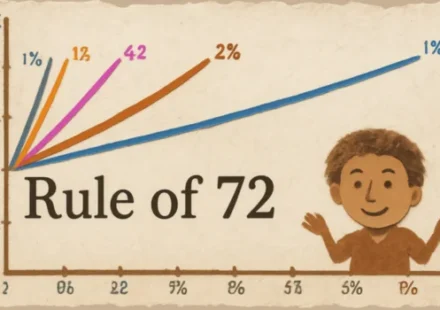
Rule of 72: How to Calculate When Your Money Will Double

If you are investing money for the long term, one of the most useful questions is: How long will it take for my money to double? You can calculate this using a simple financial shortcut called the Rule of 72. The Rule of 72 helps you estimate how many…

How to Calculate Inflation Impact on Your Savings in India
Saving money is important, but simply keeping money aside does not guarantee that your savings will maintain their value over time. One of the biggest reasons is inflation. Inflation means the general prices of goods and services increase over time. As…

Fixed Deposit vs Debt Mutual Fund: Returns, Tax and Risk Compared
Fixed deposits and debt mutual funds are two popular options for people looking for relatively lower-risk investments than equity-oriented investments. Both can be used for goals such as preserving capital, generating returns or parking money for a…

DP ID vs Client ID: Difference With Examples
When you open a Demat account in India, you receive several numbers and identifiers. Two of the most commonly confused are the DP ID and Client ID. They are not the same. The DP ID identifies the Depository Participant (DP), while the Client ID…

Can One Person Have Multiple Demat Accounts? Rules, Benefits and Limitations
Yes, one person can have multiple Demat accounts in India. There is no general requirement that an individual must maintain only one Demat account. You can have Demat accounts with different brokers or Depository Participants (DPs), and the accounts can…

Demat Account Power of Attorney: Meaning, Uses, Risks and Cancellation
A Power of Attorney (PoA) for a Demat account is an authorization given by a demat account holder to another person or entity to perform specified actions on their behalf. In the Indian stock market, PoA has traditionally been used by investors to…

Cashback vs Reward Points: Which Credit Card Benefit Is Actually More Valuable? (2026)
Credit cards offer many rewards to attract customers, but two of the most common benefits are cashback and reward points. At first glance, cashback appears simple: spend money and get some money back. Reward points can look more attractive because they…

Fixed Deposit vs Debt Mutual Fund: Which Is Better for Short-Term Goals? (2026)
When you have money that you may need within the next few months or a few years, capital safety and liquidity are usually more important than chasing the highest possible return. Two popular choices are Bank Fixed Deposits (FDs) and Debt Mutual Funds. A…

IPO UPI Mandate Pending or Failed: Causes and Solutions
When applying for an IPO in India through UPI, submitting the application is only one part of the process. The investor must also receive and approve a UPI mandate that authorizes the blocking of the application amount in the linked bank account.…

IPO Price Band vs Cut-Off Price: Key Differences
When applying for an Initial Public Offering (IPO) in India, investors often come across terms such as price band, bid price, and cut-off price. Understanding these terms is important because the price entered while applying can affect whether an IPO…