When you have money that you may need within the next few months or a few years, capital safety and liquidity are usually more important than chasing the highest possible return.
Two popular choices are Bank Fixed Deposits (FDs) and Debt Mutual Funds.
A bank FD gives you a predetermined interest rate for the selected tenure, while a debt mutual fund invests in bonds, government securities and money-market instruments. Debt-fund returns are market-linked, so the NAV can move up or down. AMFI categorises debt schemes by maturity and strategy, including liquid, ultra-short-term and short-term funds.
For short-term goals, the right choice depends on your time horizon, need for certainty, liquidity, tax position and willingness to accept small fluctuations in value.
Quick Comparison
| Feature | Bank FD | Debt Mutual Fund |
| Return Type | Fixed/contracted | Market-linked |
| Capital Value | Generally stable | Can fluctuate |
| Return Guarantee | Contracted interest rate | No guarantee |
| Interest-Rate Risk | Low for booked FD | Yes |
| Credit Risk | Bank exposure | Depends on securities held |
| Liquidity | Premature closure rules may apply | Usually redeemable on business days |
| Exit Load | Usually not applicable in the mutual-fund sense | May apply to some schemes |
| Tax Treatment | Interest taxed at applicable rate | Depends on fund and current tax rules |
| Best For | Predictability | Flexibility and market-linked debt exposure |
| Short-Term Suitability | Very high for conservative goals | Depends on fund category |
What Is a Bank Fixed Deposit?
A fixed deposit allows you to place money with a bank for a specified tenure at a predetermined interest rate.
For example, you might invest:
₹5 lakh for 1 year
at a rate offered by the bank at the time of booking.
Your return is substantially easier to estimate than a mutual fund’s return because the interest rate is known upfront.
RBI’s July 2026 data showed term-deposit rates above one year in the banking system broadly around 6.00%–6.75%, although rates vary by bank, tenure and customer category.
Why Investors Choose FDs
FDs are popular for short-term goals because they provide:
- Predictable interest
- Simple structure
- No daily NAV fluctuation
- Defined maturity date
- Easy financial planning
For money needed on a specific future date, this predictability can be valuable.
What Is a Debt Mutual Fund?
A debt mutual fund pools investors’ money and invests in fixed-income securities.
These can include:
- Government securities
- Treasury bills
- Corporate bonds
- Certificates of deposit
- Commercial paper
- Other money-market instruments
AMFI notes that debt funds can invest across government and corporate debt, and different categories are designed around different maturities and risk characteristics.
For short-term investors, categories such as:
- Overnight funds
- Liquid funds
- Money-market funds
- Ultra-short-duration funds
- Short-duration funds
may be relevant depending on the exact time horizon and risk profile. AMFI describes liquid funds as investing in securities with maturities of up to 91 days and identifies them as suitable for parking surplus funds for short periods.
FD vs Debt Fund: The Biggest Difference
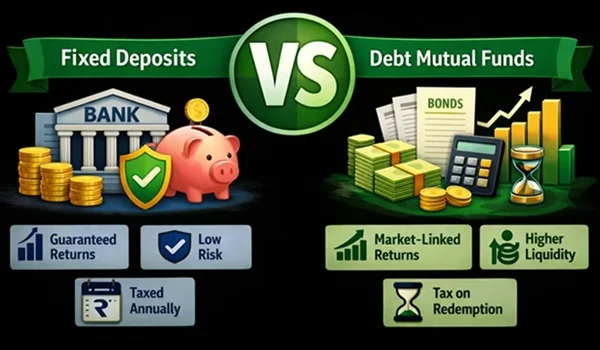
The simplest difference is:
FD = known contracted rate
Debt Fund = market-linked return
Suppose your FD rate is:
6.5%
You know the contracted interest rate when you book it, subject to the bank’s terms.
A debt fund may generate:
5.5%, 6.5%, 7%, 8% or another return
depending on interest income, bond prices, credit events, expenses and market conditions.
AMFI explicitly warns that mutual-fund returns are not guaranteed and that debt securities are affected by interest-rate, credit and liquidity risks.
Which Is Safer for Short-Term Goals?
Bank FD generally has the edge for investors who prioritise certainty.
A short-term financial goal could be:
- Car down payment in 9 months
- School fees in 6 months
- House renovation in 1 year
- Wedding expenses in 18 months
- Emergency reserve
If the money must be available at a specific time, even a temporary decline in a debt fund can create a problem.
A bank FD avoids the daily market-price fluctuations seen in mutual funds.
However, “safe” does not mean completely risk-free. Bank deposits are subject to the banking system and deposit-insurance framework, with DICGC protection subject to the applicable limit and conditions.
Debt Fund Risk for Short-Term Investors
Debt funds are often mistaken for guaranteed-return products because they invest in bonds.
They are not.
A debt fund can face:
Interest-Rate Risk
When market interest rates rise, prices of existing fixed-income securities generally fall.
When rates fall, those prices can rise.
AMFI explains this inverse relationship between bond prices and interest rates.
Credit Risk
A bond issuer may experience financial problems or default.
Liquidity Risk
Some securities may be difficult to sell quickly at favourable prices.
Reinvestment Risk
Future investments may earn lower yields if market rates fall.
These risks matter even for investors who are investing only for a short period.
Which Debt Fund Is Better for Short-Term Goals?
Not all debt funds should be treated equally.
For a very short-term goal, long-duration funds may not be appropriate because they can be more sensitive to interest-rate movements.
For a Few Days or Weeks
Overnight funds or very short-duration options may be considered, depending on your objective.
For a Few Months
Liquid funds can be relevant for investors seeking short-term parking of money. AMFI states that liquid funds invest in securities with maturities of not more than 91 days.
For Around 1 Year
Liquid, money-market or suitable ultra-short-duration strategies may be considered after checking portfolio maturity and risk.
For 1–3 Years
Short-duration debt funds can potentially be considered, but the investor should accept that the NAV can fluctuate.
A key rule is:
Choose the fund according to your goal’s time horizon—not simply according to the fund’s recent return.
FD vs Debt Fund for a Fixed Future Date
Suppose you need:
₹5 lakh exactly 12 months from now.
A bank FD can be attractive because the maturity date and contracted rate are known.
With a debt fund, the value after 12 months is uncertain.
The market could be favourable, but it could also be weaker.
For a goal with zero tolerance for shortfall, certainty may be more important than a possibility of slightly higher returns.
FD vs Debt Fund for Flexibility
Debt funds generally have an advantage in flexibility.
Mutual-fund units can normally be redeemed according to the scheme’s rules and cut-off timings.
An FD can be prematurely closed, but the bank may apply the applicable premature-withdrawal terms and the effective interest may be lower than the original contracted rate.
Some debt mutual funds may also have an exit load, so investors should check the scheme document before investing.
FD vs Debt Fund When Interest Rates Are Falling
When interest rates fall, existing bonds can become more valuable.
This can benefit debt funds, particularly those with higher interest-rate sensitivity.
An FD booked earlier generally continues at its contracted rate until maturity.
For example:
Existing FD = 6.75%
New market rate falls to 6%
Your existing FD continues under its original terms.
A debt fund holding bonds issued at older, higher yields may potentially see price appreciation.
AMFI notes that dynamic bond funds can change portfolio tenor based on interest-rate expectations, increasing duration when rates are expected to decline.
However, this is a market outcome, not a guaranteed return.
FD vs Debt Fund When Interest Rates Rise
Rising rates can create a different situation.
Existing long-duration bonds may lose value, which can reduce debt-fund NAVs.
The FD investor does not face this daily mark-to-market movement.
Instead, when the FD matures, the investor can reinvest at the prevailing higher rate.
This makes FDs particularly attractive to conservative investors during uncertain rate cycles.
Taxation: FD vs Debt Fund in 2026
Tax can significantly affect the final return.
Bank FD
Interest income from an FD is generally taxable according to the applicable tax rules and the investor’s tax slab.
So a stated FD rate of:
6.5%
does not necessarily mean you keep 6.5% after tax.
Debt Mutual Fund
Current debt-fund taxation is more complicated than older articles suggest.
Under the Section 50AA framework, qualifying specified mutual funds can have gains treated as short-term capital gains irrespective of the holding period. AMFI states that from FY 2025–26, the relevant definition covers debt-oriented mutual-fund schemes investing more than 65% of total proceeds in debt and money-market instruments, subject to the statutory conditions.
For such specified mutual funds, gains are generally taxed at the investor’s applicable slab rate under the current framework.
This means the old advice that:
“Debt fund becomes tax-efficient after 3 years because of indexation”
should not be applied blindly to current investments.
Important
Tax treatment depends on the exact fund, investment date and prevailing tax rules.
Always check the fund’s classification and current tax treatment before investing.
Example: ₹5 Lakh for One Year
Suppose you have:
₹5 lakh
and are considering an FD at an illustrative rate of:
6.5%
Approximate pre-tax interest:
₹32,500
Now suppose a debt fund generates an illustrative:
7% return
Approximate gain:
₹35,000
The apparent difference is only:
₹2,500
But the debt fund return is not guaranteed, while the FD rate is contracted.
If the debt fund returns only 5.5%, the gain would be:
₹27,500
The investor therefore needs to decide whether the possibility of a higher return is worth accepting market risk.
FD vs Debt Fund for Emergency Money
Emergency money has a special requirement:
Safety + liquidity
A short-term bank FD can be suitable if you have sufficient access to other liquid funds.
A very short-duration debt strategy may also be considered, but you should understand that mutual funds can fluctuate and do not guarantee principal.
For a true emergency reserve, it can make sense to maintain part of the money in very accessible forms rather than locking everything into a long-tenure FD.
FD vs Debt Fund for a 6-Month Goal
For six months, capital certainty is usually more important than trying to maximise returns.
A bank FD can therefore be a straightforward choice.
A liquid or very short-duration fund may also be considered by investors who understand the product and want flexibility.
But avoid choosing a long-duration debt fund just because its past returns look higher.
FD vs Debt Fund for a 1-Year Goal
At one year, the decision becomes more balanced.
You can consider:
Bank FD
when the goal date is fixed and you want predictable returns.
Liquid/money-market/ultra-short options
when liquidity is important and you can tolerate small fluctuations.
Short-duration debt fund
when your horizon permits greater NAV variability and you understand interest-rate and credit risk.
FD vs Debt Fund for a 2–3 Year Goal
For a 2–3 year horizon, suitable debt funds can become more relevant.
You have more time to absorb normal bond-market fluctuations than someone who needs the money in three months.
But the goal still matters.
Money needed for a fixed future expense should generally not be exposed to more risk than necessary.
Return vs Certainty
This is the central trade-off.
| Priority | Better Fit |
| Predictable return | FD |
| Capital stability | FD |
| Short fixed deadline | FD |
| Flexibility | Debt Fund |
| Potential benefit from falling rates | Debt Fund |
| Professional bond portfolio | Debt Fund |
| Low market volatility | FD |
| Willingness to accept NAV fluctuations | Debt Fund |
FD vs Debt Fund for Conservative Investors
FD is generally easier to understand and plan around.
A conservative investor may prefer knowing:
“I put ₹5 lakh here for one year, and I will receive the contracted amount at maturity subject to the FD terms.”
A debt-fund investor needs to accept that:
“The value may move during the holding period.”
For a short-term goal, that difference can be very important.
FD vs Debt Fund for Higher-Rate Taxpayers
Tax can change the outcome substantially.
Suppose an investor is in a high tax slab.
An FD’s interest is generally added to taxable income.
A qualifying specified debt mutual fund’s gains can also be taxed at the applicable slab rate under Section 50AA.
Therefore, investors should compare post-tax returns, not just pre-tax yields.
Don’t Compare Only Past Debt-Fund Returns
Suppose a debt fund returned:
8% last year
That does not mean it will return 8% next year.
Bond yields change.
Portfolio maturity changes.
Credit quality changes.
Market conditions change.
AMFI explicitly states that past performance does not guarantee future performance and that mutual funds are not guaranteed-return products.
For short-term goals, chasing the highest recent debt-fund return can be particularly risky.
FD Laddering for Short-Term Goals
Investors who like FDs can use FD laddering.
Suppose you have:
₹6 lakh
Instead of putting everything into one FD, you could divide it among different maturity dates.
For example:
- ₹2 lakh → 6-month FD
- ₹2 lakh → 1-year FD
- ₹2 lakh → 18-month FD
As each deposit matures, you can use the money for your upcoming goal or reinvest it at the prevailing rate.
This can provide more flexibility than locking everything into one maturity.
Debt Fund vs FD: Convenience
FD
Advantages include:
- Simple
- Easy to understand
- Known rate
- Defined maturity
Debt Fund
Advantages include:
- Professional management
- Multiple maturity strategies
- Easy portfolio diversification
- Flexible redemption
For someone who does not want to monitor market-linked instruments, FD may be more comfortable.
Debt Fund vs FD: Charges
FD
A normal bank FD typically does not have an annual fund expense ratio.
However, premature withdrawal can have financial consequences depending on bank terms.
Debt Fund
A mutual fund has an expense ratio and may have:
- Exit load
- Transaction-related costs
- Other scheme-level expenses
These costs reduce the investor’s effective return.
What Should You Choose for Different Goals?
Emergency Fund
FD / very liquid bank balance, depending on your liquidity needs.
Car Down Payment in 8 Months
FD or highly conservative short-term option
Wedding in 12 Months
FD may be preferable for certainty
Business Working Capital in 6–12 Months
Liquidity-focused debt option or FD, depending on cash-flow needs.
Child’s School Fee in 6 Months
FD or highly liquid low-volatility option
Goal in 2–3 Years
FD or carefully selected short-duration debt fund
Money You Don’t Need for 5+ Years
A broader asset-allocation decision may be more appropriate rather than automatically choosing a short-term debt product.
A Practical Decision Framework
Before investing, ask five questions.
- When exactly will I need the money?
Three months and three years are very different horizons.
- Can the amount fluctuate?
If the answer is no, an FD may be more appropriate.
- Do I need instant liquidity?
If yes, avoid locking the entire amount.
- What is my tax rate?
Compare post-tax returns.
- What happens if the investment falls temporarily?
If a temporary decline would force you to sell at a loss, choose a lower-risk option.
Common Mistakes to Avoid
Choosing a Debt Fund Based Only on Return
A high past return may have come from favourable bond-price movements.
Using Long-Duration Debt Funds for Very Short Goals
The longer the duration, the more sensitive the fund can be to interest-rate movements.
Ignoring Credit Quality
Higher-yield debt can involve higher credit risk.
Ignoring Taxes
Always compare post-tax outcomes.
Locking All Money Into One FD
If interest rates move, you may lose flexibility.
Treating Debt Funds Like FDs
They are not the same product. AMFI clearly states that mutual-fund returns are not guaranteed.
Final Verdict
For a short-term financial goal where the amount must be available on a known date, a bank FD is often the more straightforward choice because the return is contracted and capital does not fluctuate with daily bond-market movements.
A debt mutual fund can be attractive when you want greater liquidity, professional management or potential benefits from bond-market movements, but you must accept interest-rate, credit and market risks.
For 2026, taxation is also an important consideration because qualifying debt-oriented mutual funds can fall under the Section 50AA specified-mutual-fund framework, with gains generally treated as short-term and taxed at applicable slab rates.
Bottom Line
Choose an FD when:
your goal is short-term, the date is fixed, and capital certainty matters most.
Consider a debt fund when:
you want flexibility, understand NAV fluctuations and select a fund whose maturity and risk profile match your horizon.
There is no need to choose a product simply because it has the higher advertised return.
For short-term money, the priority should usually be:
Safety → Liquidity → Tax efficiency → Return
rather than:
Maximum possible return at any cost.
FAQs
Is an FD better than a debt mutual fund for 1 year?
For a fixed one-year goal where you cannot afford a shortfall, an FD is often easier to plan around because the interest rate is contracted. A suitable liquid or short-duration debt fund can provide flexibility but does not guarantee the final value.
Can debt mutual funds lose money?
Yes. Debt funds can lose value because of interest-rate movements, credit events or liquidity conditions. AMFI specifically warns that debt securities can face credit risk, interest-rate risk and market-related price fluctuations.
Which debt fund is suitable for short-term investment?
The answer depends on the exact time horizon. Liquid and money-market funds may be relevant for very short periods, while ultra-short and short-duration funds can be considered for somewhat longer horizons. AMFI identifies liquid funds as investing in securities with maturities of up to 91 days.
Are debt mutual-fund returns guaranteed like FD interest?
No. Mutual funds are market-linked products and do not provide guaranteed or assured returns.
Is debt-fund taxation still better than FD taxation after three years?
Do not rely on the old three-year/indexation comparison for current qualifying debt funds. Under Section 50AA, specified debt-oriented mutual funds can have gains treated as short-term and taxed at applicable slab rates.
Which is better for an emergency fund: FD or debt fund?
For emergency money, liquidity and stability are more important than squeezing out a small additional return. A combination of easily accessible bank savings and suitable short-term deposits can be considered; very liquid debt funds may also be an option for investors who understand that mutual-fund values are not guaranteed.