If you are investing money for the long term, one of the most useful questions is: How long will it take for my money to double?
You can calculate this using a simple financial shortcut called the Rule of 72.
The Rule of 72 helps you estimate how many years an investment may take to double based on its annual rate of return. It does not require a calculator with complicated financial functions, making it useful for quickly comparing different investment returns.
For example, if an investment earns an average return of 8% per year, the Rule of 72 estimates that the money could take about 9 years to double.
However, the Rule of 72 is an approximation. Actual investment returns may vary, and taxes, fees, inflation and compounding frequency can affect the final result.
What Is the Rule of 72?
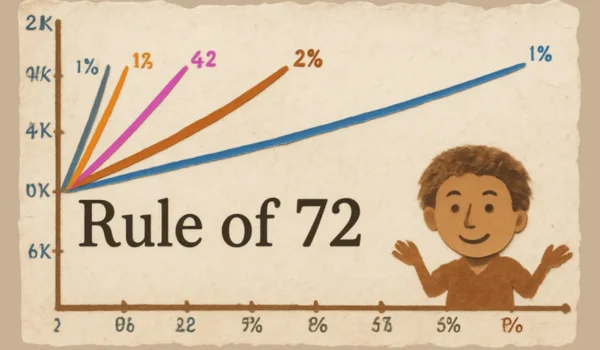
The Rule of 72 is a simple mathematical formula used to estimate the time required for an investment to double when returns are compounded.
The basic formula is:
Years to Double = 72 ÷ Annual Rate of Return
For example:
72 ÷ 8 = 9 years
So, at an assumed annual return of 8%, your money may approximately double in 9 years.
Similarly, at a 12% return:
72 ÷ 12 = 6 years
The calculation is simple, but the result should be treated as an estimate rather than a guaranteed outcome.
Rule of 72 Examples
Here is how the estimated doubling period changes with different annual returns:
| Annual Return | Approximate Time to Double |
| 3% | 24 years |
| 4% | 18 years |
| 5% | 14.4 years |
| 6% | 12 years |
| 7% | 10.3 years |
| 8% | 9 years |
| 9% | 8 years |
| 10% | 7.2 years |
| 12% | 6 years |
| 15% | 4.8 years |
| 18% | 4 years |
| 20% | 3.6 years |
These figures assume the stated annual return is consistently compounded, which may not happen with actual investments.
How Does the Rule of 72 Work?
The Rule of 72 is based on the mathematical relationship between compound growth and doubling.
Compound interest means that returns are added to your investment and subsequent returns can be earned on the accumulated amount.
Suppose you invest ₹1 lakh and earn a constant 10% annual return.
The approximate calculation is:
72 ÷ 10 = 7.2 years
So, the Rule of 72 estimates that ₹1 lakh could become ₹2 lakh in about 7.2 years.
The actual mathematical doubling time at a constant 10% compounded annually is approximately 7.27 years, showing why the Rule of 72 works well as a quick estimate.
Rule of 72 Formula
The formula is:
Doubling Time = 72 ÷ Rate of Return
If you know the investment’s expected return, simply divide 72 by that percentage.
Example 1: 6% Return
72 ÷ 6 = 12 years
At a constant 6% annual compound return, money may approximately double in 12 years.
Example 2: 8% Return
72 ÷ 8 = 9 years
Example 3: 12% Return
72 ÷ 12 = 6 years
Example 4: 15% Return
72 ÷ 15 = 4.8 years
The higher the annual return, the shorter the estimated doubling period.
How Much Will ₹1 Lakh Become?
Suppose you invest ₹1 lakh and the investment earns a constant 8% annually.
Using the Rule of 72:
72 ÷ 8 = 9 years
So, after approximately 9 years:
₹1 lakh → ₹2 lakh
After another 9 years:
₹2 lakh → ₹4 lakh
After another 9 years:
₹4 lakh → ₹8 lakh
This illustrates the power of compounding.
The time required for each doubling remains approximately the same only when the assumed return remains constant.
Rule of 72 and Compound Interest
The Rule of 72 is useful because it gives a quick approximation of compound growth without requiring a detailed calculation.
The exact future value formula is:
Future Value = Principal × (1 + Rate)ⁿ
Where:
- Principal = initial investment
- Rate = annual return expressed as a decimal
- n = number of years
For example, with ₹1 lakh invested at 8% for 10 years:
Future Value = ₹1,00,000 × (1.08)¹⁰
The result is approximately ₹2.16 lakh.
The Rule of 72 estimates a doubling period of 9 years, which means the money would reach around ₹2 lakh after approximately that period.
Rule of 72 vs Exact Calculation
The Rule of 72 is a shortcut, not a replacement for exact calculations.
For example, at a 10% annual return:
Rule of 72:
72 ÷ 10 = 7.2 years
The exact annual-compounding doubling time is approximately:
7.27 years
The difference is small.
However, the approximation can become less precise at very high or very low rates.
For important financial decisions, use an exact compound-interest calculation rather than relying only on the Rule of 72.
Rule of 72 for Fixed Deposits
The Rule of 72 can provide a quick way to understand how long an FD could take to double if the applicable return remained constant and the interest were effectively compounded.
For example, at an assumed 7% annual rate:
72 ÷ 7 = approximately 10.3 years
However, this should not be interpreted as a guaranteed doubling period for every FD.
FD interest rates depend on the bank, tenure and product. Taxation also affects the amount you actually retain.
If interest is taxable, your post-tax return can be lower than the advertised rate.
Therefore, an investor should distinguish between the nominal FD rate and the effective return after tax.
Rule of 72 for Mutual Funds
The Rule of 72 can also be used to estimate the doubling period for an assumed mutual fund return.
Suppose you assume a mutual fund investment generates an average long-term return of 10%.
72 ÷ 10 = 7.2 years
But mutual funds do not generally provide fixed returns.
For an equity mutual fund, for example, returns can fluctuate substantially from year to year.
Therefore, you should use a realistic assumed long-term return rather than treating the result as a promise that your investment will double in exactly 7.2 years.
Rule of 72 for Stocks
The same formula can be used for an assumed stock-market return.
Suppose an investor assumes a 12% annual return:
72 ÷ 12 = 6 years
This means the investment could theoretically double in about six years if it actually compounds at 12% every year.
In real markets, annual returns are not constant.
One year may produce a positive return, while another may produce a loss.
Therefore, the Rule of 72 is useful for understanding the effect of a long-term average return, not for predicting when a particular stock will double.
Rule of 72 and Inflation
The Rule of 72 can also be used to understand inflation.
If inflation averages 6% per year, prices could approximately double in:
72 ÷ 6 = 12 years
This does not mean every product will exactly double in 12 years. Different goods and services experience different price changes.
However, it provides a useful illustration of how inflation can reduce purchasing power.
For example, if your expenses increase at an average rate of 6%, a financial goal costing ₹10 lakh today could eventually require roughly twice that amount after around 12 years under that constant inflation assumption.
Investment Return vs Inflation
One of the most important uses of the Rule of 72 is comparing investment growth with inflation.
Suppose:
- Investment return = 8%
- Inflation = 6%
Using the Rule of 72:
Investment doubling time = 72 ÷ 8 = 9 years
Price-level doubling time = 72 ÷ 6 = 12 years
This suggests that the investment’s nominal value may grow faster than the general price level under these assumptions.
However, taxes and investment costs can reduce the effective return.
For long-term financial planning, what matters is not just whether your money doubles, but whether its purchasing power grows.
Can the Rule of 72 Be Used for Debt?
Yes.
The Rule of 72 can also provide a rough indication of how quickly debt can grow when interest compounds.
Suppose a debt effectively compounds at 18% annually:
72 ÷ 18 = 4 years
This means the amount could theoretically double in roughly four years if the rate remained constant and the interest compounded without repayments.
Actual loans can work differently because of EMI payments, reducing balances, fees and changing interest rates.
So the Rule of 72 should only be treated as a conceptual illustration for loans.
Rule of 72 for Credit Card Debt
Credit card interest can be high compared with many traditional borrowing products.
If a hypothetical balance effectively compounds at 24% annually:
72 ÷ 24 = 3 years
The theoretical doubling period would be around three years if no payments were made and the rate and compounding assumptions remained constant.
In practice, credit cards involve minimum payments, fees, interest calculations and other terms, so the actual balance will depend on how the account is managed.
Rule of 72 for SIP Investments
The Rule of 72 can help explain compounding in a SIP, but it should be used carefully.
A SIP involves multiple investments made over time, rather than one lump sum invested on day one.
The Rule of 72 is most directly applicable to a lump sum growing at a constant compound rate.
For a SIP, the actual value depends on:
- Amount invested each month
- Investment period
- Market returns
- Timing of each investment
- Expense ratio and other costs
- Taxes where applicable
Therefore, do not use the Rule of 72 to claim that a particular SIP will double after a fixed number of years.
Why Rule of 72 Is Useful for Investors
The main advantage of the Rule of 72 is simplicity.
It can help you quickly compare the impact of different returns.
For example:
- 6% return → around 12 years
- 8% return → around 9 years
- 10% return → around 7.2 years
- 12% return → around 6 years
A small difference in annual return can therefore make a significant difference over long periods.
This is one reason compounding is so important in financial planning.
Limitations of the Rule of 72
The Rule of 72 has several limitations.
- It Is an Approximation
It does not provide an exact doubling period.
- Returns May Not Be Constant
Actual investments rarely earn the same return every year.
- Taxes Are Ignored
The formula generally uses the stated return before considering personal tax effects.
- Investment Costs Are Ignored
Fees and expenses can reduce actual returns.
- It Does Not Measure Risk
Two investments may have the same expected return but very different levels of risk.
- It Does Not Guarantee Doubling
The calculation is mathematical, not a prediction of investment performance.
Rule of 72 vs Rule of 70
You may also hear about the Rule of 70.
The concept is similar:
Doubling Time = 70 ÷ Growth Rate
The Rule of 70 can sometimes be used for estimating population or economic growth and other compounding situations.
The Rule of 72 is popular in personal finance because 72 is easy to divide by several common percentages, including 6, 8, 9 and 12.
How to Use the Rule of 72 in Financial Planning
You can use it as a quick screening tool.
Step 1: Choose an Assumed Return
For example, assume 8%.
Step 2: Divide 72 by the Return
72 ÷ 8 = 9 years
Step 3: Consider Inflation
If inflation is 6%, its approximate doubling period is:
72 ÷ 6 = 12 years
Step 4: Consider Tax and Costs
Your actual post-tax return may be lower.
Step 5: Use Exact Calculations for Final Planning
For retirement, education or other major financial goals, use a detailed calculation based on your expected contributions, returns, inflation and taxes.
Frequently Asked Questions
Is the Rule of 72 accurate?
It is a useful approximation for estimating doubling time, particularly at moderate rates of return. It is not an exact mathematical formula.
What is the Rule of 72 for 10% return?
At a 10% annual return:
72 ÷ 10 = 7.2 years
So the estimated doubling period is about 7.2 years.
How long does it take to double money at 12%?
Using the Rule of 72:
72 ÷ 12 = 6 years
How long does money take to double at 6%?
72 ÷ 6 = 12 years
Can I use the Rule of 72 for SIP?
You can use it to understand the effect of an assumed compound return, but it does not directly calculate the doubling period of a SIP because SIP investments are made periodically.
Does the Rule of 72 include inflation?
Not automatically. You can separately use the Rule of 72 to estimate the approximate doubling time of prices based on an assumed inflation rate.
Final Thoughts
The Rule of 72 is a simple way to understand the power of compound growth.
The basic formula is:
Years to Double = 72 ÷ Annual Return
At an assumed 8% annual return, the estimated doubling period is about 9 years. At 12%, it is about 6 years.
However, actual investments do not normally generate fixed returns every year. Taxes, fees, inflation and market fluctuations can also change the outcome.
Use the Rule of 72 as a quick financial-planning shortcut, not as a guarantee of future investment performance. For important investment decisions, combine it with detailed calculations that consider your actual investment, time horizon, risk and post-tax returns.