Saving money is important, but simply keeping money aside does not guarantee that your savings will maintain their value over time. One of the biggest reasons is inflation.
Inflation means the general prices of goods and services increase over time. As prices rise, the purchasing power of money falls.
For example, ₹1 lakh today can buy more goods and services than ₹1 lakh several years from now if prices continue to increase.
This is why understanding the inflation impact on savings is important when planning for education, a home, retirement, healthcare or any other long-term financial goal.
The good news is that you can estimate the future value of your savings and calculate the amount of money you may need using simple inflation formulas.
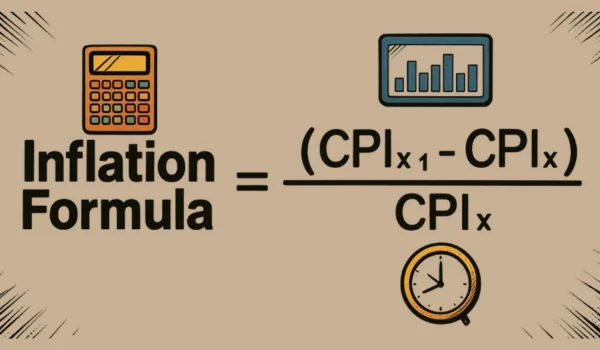
What Is Inflation?
Inflation is the increase in the general price level of goods and services over time.
In India, inflation is commonly tracked using measures such as the Consumer Price Index (CPI). The actual inflation rate can change from year to year.
For personal financial planning, you can use an assumed annual inflation rate to estimate how much your future expenses may increase.
For example, if you assume inflation of 6% per year, an expense of ₹1 lakh today would become approximately ₹1.06 lakh after one year.
After several years, the effect becomes much larger because inflation compounds.
How Does Inflation Affect Your Savings?
Inflation affects savings in two main ways:
- Your money buys fewer goods and services in the future.
- The return on your savings may not keep pace with inflation.
Suppose you have ₹5 lakh in a savings account and the account earns 3% per year, while inflation averages 6%.
Your money is increasing in nominal terms, but its purchasing power may still be declining.
This is known as a negative real return.
Simple Example
Suppose:
- Savings = ₹5 lakh
- Annual return = 3%
- Inflation = 6%
The approximate difference between the nominal return and inflation is:
3% − 6% = −3%
This is a simplified way of looking at the real return. The exact real return is slightly different because inflation and investment returns compound.
Inflation Impact Formula
One of the simplest formulas for calculating the future cost of something is:
Future Cost = Current Cost × (1 + Inflation Rate)ⁿ
Where:
- Current Cost = today’s cost
- Inflation Rate = expected annual inflation
- n = number of years
Example
Suppose your current annual household expense is ₹6 lakh and you assume inflation of 6%.
After 10 years:
Future Cost = ₹6,00,000 × (1.06)¹⁰
This gives approximately:
₹10.75 lakh
So, an expense of ₹6 lakh today could require around ₹10.75 lakh per year after 10 years if inflation averages 6%.
This is an estimate, not a guarantee.
How to Calculate the Future Value of Your Savings
If you already have savings and want to know how much they may grow to at a particular return, you can use:
Future Value = Current Savings × (1 + Return Rate)ⁿ
Suppose you have ₹5 lakh and it earns an average return of 7% per year for 10 years.
Future Value = ₹5,00,000 × (1.07)¹⁰
The result is approximately:
₹9.84 lakh
However, this does not tell you how much purchasing power that ₹9.84 lakh will have.
To understand that, inflation must also be considered.
How to Calculate the Real Value of Your Savings
To estimate the purchasing power of future savings in today’s money:
Real Value = Future Savings ÷ (1 + Inflation Rate)ⁿ
Suppose your ₹5 lakh grows to approximately ₹9.84 lakh over 10 years at 7% annual growth, while inflation averages 6%.
The purchasing power in today’s terms would be approximately:
₹9.84 lakh ÷ (1.06)¹⁰
That is about:
₹5.50 lakh in today’s purchasing power.
This shows why a return of 7% does not mean your purchasing power has increased by 7%.
Inflation vs Investment Return
A useful concept in financial planning is the real rate of return.
A more accurate formula is:
Real Return = [(1 + Investment Return) ÷ (1 + Inflation Rate)] − 1
For example, if your investment earns 8% and inflation is 6%:
Real Return = (1.08 ÷ 1.06) − 1
The real return is approximately:
1.89%
This is more accurate than simply subtracting 6% from 8%.
The difference becomes important when you are planning long-term goals.
How Inflation Changes the Cost of Your Goals
Inflation becomes particularly important for long-term financial goals.
Consider a goal that costs ₹10 lakh today.
If you assume 6% annual inflation:
| Time | Approximate Future Cost |
| Today | ₹10 lakh |
| 5 years | ₹13.38 lakh |
| 10 years | ₹17.91 lakh |
| 15 years | ₹23.97 lakh |
| 20 years | ₹32.07 lakh |
| 25 years | ₹42.92 lakh |
These numbers are illustrative and assume a constant 6% inflation rate every year.
Actual inflation can be higher or lower.
How to Calculate Inflation Impact on ₹1 Lakh
A simple way to understand inflation is to see what happens to ₹1 lakh.
Assuming 6% annual inflation:
| Period | Cost Equivalent of ₹1 Lakh Today |
| Today | ₹1.00 lakh |
| 5 years | ₹1.34 lakh |
| 10 years | ₹1.79 lakh |
| 15 years | ₹2.40 lakh |
| 20 years | ₹3.21 lakh |
| 25 years | ₹4.29 lakh |
Therefore, if something costs ₹1 lakh today, you may need approximately ₹4.29 lakh after 25 years to buy something with a similar price level under a constant 6% inflation assumption.
How Much Will Your Savings Be Worth in Today’s Money?
You can also calculate the opposite.
Suppose you expect to have ₹20 lakh after 15 years and assume 6% inflation.
The purchasing power in today’s terms would be:
₹20 lakh ÷ (1.06)¹⁵
This is approximately:
₹8.34 lakh
In other words, ₹20 lakh after 15 years would have purchasing power similar to roughly ₹8.34 lakh today under this inflation assumption.
This is one of the most important calculations for long-term financial planning.
Inflation Impact on Different Types of Savings
Different savings products may respond differently to inflation.
| Savings Option | Inflation Consideration |
| Cash | Purchasing power can decline directly with inflation |
| Savings account | Return may be lower than inflation |
| Fixed deposit | Return is predetermined, but may or may not beat inflation |
| Debt mutual fund | Returns are market-linked and not guaranteed |
| Gold | Price can change with market conditions; not a guaranteed inflation hedge |
| Equity investments | Can offer long-term growth potential but carry market risk |
| PPF | Interest rate is notified periodically and subject to applicable rules |
| Real estate | Prices and rental income can change, but returns are not guaranteed |
No investment automatically protects you from inflation.
The right comparison is between the after-tax return of an investment and the inflation relevant to your spending needs.
Inflation and Fixed Deposits
Fixed deposits are popular among Indian savers because they provide a predetermined interest rate for the chosen tenure.
However, the FD rate should be compared with inflation and taxation.
For example, suppose:
- FD return = 7%
- Inflation = 6%
- Tax on interest reduces your effective return
Your post-tax return may be considerably lower than 7%.
This means an FD can grow your money in nominal terms while providing limited growth in purchasing power.
Therefore, when comparing FDs, look at the post-tax real return, not just the advertised interest rate.
Inflation and Retirement Planning
Inflation is particularly important for retirement planning because retirement may last for several decades.
Suppose your current monthly household expenses are ₹50,000.
At 6% annual inflation, after 20 years the equivalent monthly expense would be approximately:
₹50,000 × (1.06)²⁰
= approximately ₹1.60 lakh per month
So, someone planning retirement cannot simply assume that today’s ₹50,000 monthly expenses will remain ₹50,000 in the future.
Healthcare, housing, food and other expenses can also experience different rates of price increase.
Inflation Can Differ for Different Expenses
The inflation rate you experience personally may not be exactly the same as the headline inflation rate.
For example, a household spending heavily on:
- Education
- Healthcare
- Housing
- Travel
- Food
may experience a different increase in total expenses compared with another household.
Therefore, financial planning should use a reasonable inflation assumption based on the goal rather than blindly using one number for everything.
For long-term goals, it can also be useful to calculate multiple scenarios.
Example
For a ₹10 lakh current goal:
| Assumed Inflation | Cost After 10 Years |
| 4% | ₹14.80 lakh |
| 6% | ₹17.91 lakh |
| 8% | ₹21.59 lakh |
| 10% | ₹25.94 lakh |
This shows how strongly the assumed inflation rate can affect long-term planning.
How to Protect Savings From Inflation
You cannot control inflation, but you can plan around it.
- Set Inflation-Adjusted Goals
Instead of saying, “I need ₹20 lakh for my child’s education,” estimate what that goal may cost when the money is actually required.
- Compare Real Returns
Look at:
Investment Return − Inflation − Taxes
For a more accurate calculation, use the real-return formula rather than simply subtracting percentages.
- Diversify
Depending on your goals and risk tolerance, you may use a combination of savings, fixed-income investments and growth-oriented investments.
- Review Your Goals Regularly
If inflation assumptions or your income changes, update your financial plan.
- Avoid Keeping All Long-Term Money in Low-Return Options
Safety and liquidity are important, but keeping all long-term savings in instruments that consistently earn less than inflation can reduce future purchasing power.
Common Mistakes When Calculating Inflation
Ignoring Compounding
Inflation compounds over time. A 6% increase every year does not mean prices simply increase by 60% after 10 years.
Using Today’s Expenses for Future Goals
A future goal should generally be adjusted for inflation.
Ignoring Taxes
A nominal return is not the same as a post-tax return.
Assuming Inflation Will Remain Constant
Inflation changes over time. A 6% assumption is only a planning assumption.
Looking Only at Investment Returns
An investment earning 8% is not automatically generating 8% growth in purchasing power.
Quick Inflation Calculation Formula
For future expenses:
Future Cost = Current Cost × (1 + Inflation Rate)ⁿ
For future savings:
Future Savings = Current Savings × (1 + Return Rate)ⁿ
For purchasing power:
Today’s Value = Future Amount ÷ (1 + Inflation Rate)ⁿ
For real return:
Real Return = [(1 + Return) ÷ (1 + Inflation)] − 1
These four formulas can help you understand the basic relationship between inflation, savings and investment returns.
Final Thoughts
Inflation can have a major impact on long-term savings because the value of money is measured not only by the amount you have but also by what that money can buy.
If you have ₹10 lakh today, the same ₹10 lakh may not provide the same purchasing power 10 or 20 years from now.
For this reason, financial planning should consider future expenses, inflation, investment returns and taxes together.
The most useful approach is to calculate the future cost of your financial goals, compare your expected post-tax investment returns with inflation and review the assumptions periodically. This can help you avoid underestimating how much money you may actually need in the future.