When buying a new flat, apartment or house, buyers often hear two important terms: Completion Certificate (CC) and Occupancy Certificate (OC).
Although the two documents are related, they are not necessarily the same.
A Completion Certificate generally relates to the completion of construction in accordance with the sanctioned plan and applicable requirements. An Occupancy Certificate generally relates to permission from the competent authority to occupy the completed building, subject to local laws.
Under the Real Estate (Regulation and Development) Act, 2016 (RERA), an Occupancy Certificate means a certificate or similar document issued by the competent authority permitting occupation of a building under local laws, with provision for civic infrastructure such as water, sanitation and electricity.
For a homebuyer, understanding the difference is important before taking possession of a property.
What Is a Completion Certificate?
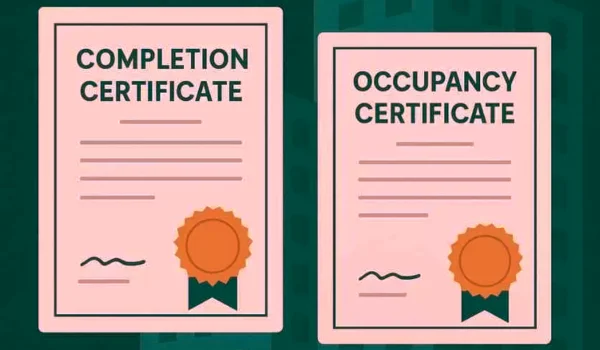
A Completion Certificate is generally issued after the construction work has been completed and the competent authority is satisfied that the project or building has been constructed according to the approved plans and applicable building requirements.
The exact procedure differs between states and local authorities.
A completion-related certification may involve details such as:
- Approved building plans
- Actual construction
- Structural requirements
- Building regulations
- Development works
- Required technical certificates
- Fire safety requirements, where applicable
- Other local authority conditions
For example, Maharashtra’s Unified Development Control and Promotion Regulations provide for submission of a building completion certificate by the owner through the architect, licensed engineer, town planner or supervisor. The regulations also provide for inspection before the occupancy certificate is issued.
What Is an Occupancy Certificate?
An Occupancy Certificate (OC) is a certificate issued by the competent authority permitting occupation of a building, as provided under applicable local laws.
Under RERA, the definition specifically refers to permission to occupy a building and the provision of civic infrastructure such as water, sanitation and electricity.
In simple terms:
Completion Certificate: The construction has been completed in accordance with applicable requirements.
Occupancy Certificate: The competent authority permits the building to be occupied, subject to the applicable local requirements.
Occupancy Certificate vs Completion Certificate
| Point | Completion Certificate (CC) | Occupancy Certificate (OC) |
| Main purpose | Certifies completion of construction/development as required | Permits occupation of the building |
| Focus | Construction and compliance | Occupation and habitability under local law |
| Issued by | Relevant competent authority/process under local rules | Competent local authority |
| When obtained | After construction reaches the required stage | Generally after completion-related compliance and inspection |
| Important for buyer? | Yes | Yes |
| Same document? | No | No |
| Exact requirements | Depend on local building regulations | Depend on local building regulations |
The sequence is not identical in every jurisdiction. Local laws may use different terminology or combine certain certificates.
Which Is More Important for a Homebuyer?
A buyer should not treat OC and CC as interchangeable documents.
The OC is particularly important because it relates to permission to occupy the building.
RERA itself connects possession with the promoter’s obligations regarding the occupancy certificate. Section 17 provides that, in the absence of applicable local law, the conveyance is to be carried out within three months from the date of issue of the occupancy certificate. It also provides for handover of necessary documents and plans after obtaining the occupancy certificate and handing over physical possession.
However, this does not mean that a buyer should ignore the Completion Certificate.
The CC and other completion-related documents can help establish whether the project has been completed according to the sanctioned plans and applicable requirements.
Why Is an Occupancy Certificate Important?
An OC can be particularly important for a buyer for several reasons.
- It Relates to Legal Occupation
The primary purpose of an OC is to permit occupation under the applicable local law.
- It Helps During Possession
Before accepting possession, a buyer should check whether the required occupancy approval has been obtained for the relevant building or project.
- It Can Matter for Utilities
Depending on local rules, occupation approval can be connected with civic infrastructure and utility requirements.
- It Can Matter for Future Transactions
When selling or transferring a property later, buyers, lenders or authorities may ask for occupation-related documents.
- It Helps Identify Approval Issues
If the authority has not issued the required occupation certificate, the buyer should understand why before taking possession.
Why Is a Completion Certificate Important?
The Completion Certificate is important because it relates to whether the construction has been completed as required.
It can help establish that the completed construction has gone through the applicable completion process.
For example, local development regulations may require the completion certificate to be accompanied by approved plans, structural stability certification or other documents.
Maharashtra’s development regulations, for example, specify supporting documents such as completed development plans and, where necessary, structural stability and fire-related certificates as part of the completion process.
Can a Building Have a Completion Certificate but No Occupancy Certificate?
The answer depends on the applicable local law and the stage of approval.
Completion and occupation are separate concepts. A building may have reached the construction-completion stage, but the authority may still need to complete inspection or other formalities before granting permission for occupation.
Therefore, a buyer should not assume:
“The builder says the building is complete, so I can legally occupy it.”
Ask specifically for the applicable Occupancy Certificate and verify whether it covers the building and unit concerned.
Can a Builder Give Possession Without an OC?
The legal position can depend on the applicable state and local laws, the nature of the project and the wording of the relevant approvals.
For a RERA-covered project, an allottee should carefully verify the required occupation approval before accepting possession.
RERA defines an OC as the certificate or equivalent document permitting occupation under local laws.
If a builder asks you to take possession while saying that the OC will be obtained later, ask for the reason in writing and verify the position with the relevant authority or a property lawyer.
What Should a Homebuyer Check Before Taking Possession?
Do not check only the OC.
A practical possession checklist should include:
- Occupancy Certificate
- Completion Certificate, where applicable
- Approved building plan
- Sanctioned layout
- RERA project details
- Possession letter
- Agreement for sale
- Sale/conveyance documentation
- Fire safety approval, where applicable
- Electricity and water arrangements
- Lift-related approvals, where applicable
- Property tax-related documents
- Maintenance and common-area information
- Any pending approvals or conditions
The exact documents depend on the project and local authority.
How to Verify an Occupancy Certificate
The verification method varies by city and state.
A buyer can:
- Ask the builder for a copy of the OC.
- Check the issuing authority.
- Verify the certificate number and date.
- Check the project/building details mentioned in it.
- Confirm that it covers the relevant building or phase.
- Check whether any conditions or limitations are mentioned.
- Verify it through the local authority’s online system, where available.
- Compare the approved plans with the actual property where necessary.
For large projects, check whether the OC applies to the entire project or only a particular tower, building or phase.
This distinction can be important.
What If the OC Is Only for One Phase?
Large housing projects are often developed in multiple phases.
An OC may therefore relate to:
- One tower
- One building
- One phase
- A particular portion of the project
- The entire project
Do not assume that an OC for one building automatically covers every building in the project.
Check the exact description in the certificate.
OC vs CC vs Possession Letter
These documents serve different purposes.
| Document | What It Generally Indicates |
| Completion Certificate | Construction/development has completed the required completion process |
| Occupancy Certificate | Authority permits occupation under applicable local law |
| Possession Letter | Builder/developer offers or records handover of possession to the buyer |
A possession letter is not automatically a substitute for an OC.
The buyer should check the regulatory and local-authority documents separately.
Does OC Mean the Property Has a Clear Title?
No.
This is an important distinction.
An OC generally concerns the building’s occupation and compliance under applicable local rules. It does not by itself prove that:
- The seller has perfect title
- The land title is free from disputes
- There are no mortgages
- There are no pending court cases
- All property dues are paid
- Every document in the title chain is valid
A buyer should separately conduct title and legal due diligence.
What If the Building Has Deviations From the Approved Plan?
This can be a serious issue.
A building may have differences between the approved plan and the actual construction.
Depending on the nature and extent of the deviation, the authority may:
- Require correction
- Require revised approval
- Refuse occupation approval
- Permit regularisation where the law allows
- Take other action under applicable regulations
Maharashtra’s development regulations, for example, state that substantial deviations from sanctioned plans require authority approval and describe unauthorised construction in specified circumstances.
A buyer should therefore compare the approved plans and actual property where there is a reason to suspect unauthorised construction.
What Happens If the Builder Has Not Obtained the Required OC?
Do not simply rely on verbal assurances.
Ask the builder:
- Why has the OC not been issued?
- Has the application been submitted?
- Is the application pending with the authority?
- Are there construction deviations?
- Are any NOCs pending?
- Does the existing certificate cover the relevant tower?
- When is the expected approval?
Keep written records of communications.
If the project falls under RERA, an allottee may also consider the remedies available under the applicable RERA framework and state rules.
OC and CC: Simple Example
Suppose a builder constructs a residential tower.
After construction, the builder completes the required completion process and submits the necessary documents to the authority.
The authority checks the building and applicable requirements.
The Completion Certificate relates to completion of the construction process.
After the authority is satisfied with the requirements for occupation, it issues the Occupancy Certificate permitting occupation under the applicable local law.
For the homebuyer, both documents can therefore be relevant, but the OC has a direct connection with the legal permission to occupy.
Frequently Asked Questions
Is an OC the same as a Completion Certificate?
No. They generally serve different purposes. A Completion Certificate relates to completion of construction, while an Occupancy Certificate relates to permission to occupy the building under applicable local laws.
Which certificate should I ask for before taking possession?
Ask for the applicable Occupancy Certificate as well as the Completion Certificate and other required approvals. The exact requirements depend on the local authority and project.
Can I register my flat without an OC?
Registration and occupation approval are separate legal matters. The applicable requirements can vary by state and transaction. Do not assume that registration of a sale deed automatically means the building has all required occupation approvals.
Does every property have both an OC and CC?
Not necessarily in exactly the same form. Terminology and procedures vary between states and local authorities. Some authorities may combine or use different names for certain approvals.
Is OC important for a resale flat?
Yes, it can be an important document to check. A resale buyer should examine the property’s occupation approval along with title documents, previous sale deeds, encumbrance records and other relevant approvals.
Can a bank give a home loan without an OC?
Lender requirements vary. A bank or housing finance company may conduct its own legal and technical due diligence and may ask for specific approvals depending on the property.
What if the builder says the OC is “under process”?
Ask for documentary evidence of the application and find out whether the relevant authority has raised any objections. Before accepting possession, independently verify the applicable requirements.
Conclusion
The Completion Certificate and Occupancy Certificate are related but different documents.
The Completion Certificate generally concerns completion of construction according to the applicable requirements, while the Occupancy Certificate concerns permission to occupy the building under local law.
For a homebuyer, obtaining and verifying the required OC, CC, sanctioned plans and other approvals before taking possession can help identify regulatory or construction-related issues.
Most importantly, do not rely only on the builder’s statement that a project is “complete.” Check the actual documents, verify which building or phase they cover, and take professional legal advice if there is any uncertainty about the property’s approvals or title.