Railway stations play an important role in the movement of parcels, luggage and commercial consignments across India. Businesses often use rail transport to move goods between cities because railway parcel services can connect major markets and towns across the country.
This creates business opportunities around parcel booking, parcel collection, packing, loading support, logistics and courier services.
However, there is an important difference between a Railway parcel business and a private courier business near a railway station. Railway parcel booking is an official railway service, while a private courier company normally operates under its own logistics network. Businesses operating on railway premises may also require specific railway authorisation, contracts or licences.
Indian Railways continues to modernise parcel operations. In 2025, Railway Board introduced online indenting of Parcel Vans through the Freight Business Development portal, and manual indenting for specified Parcel Van arrangements was discontinued from July 1, 2025.
Quick Information
| Factor | Details |
| Business Type | Parcel, courier and logistics services |
| Main Customers | Businesses, traders and passengers |
| Main Services | Booking, collection, packing and delivery support |
| Location | Railway station, parcel office or nearby private premises |
| Railway Business Model | Railway parcel booking/authorised contract |
| Private Business Model | Courier, logistics or collection service |
| Revenue Sources | Service charges, commissions and logistics fees |
| Main Advantage | Access to railway connectivity |
| Major Requirement | Appropriate railway or business authorisation |
What Is Railway Parcel Business?
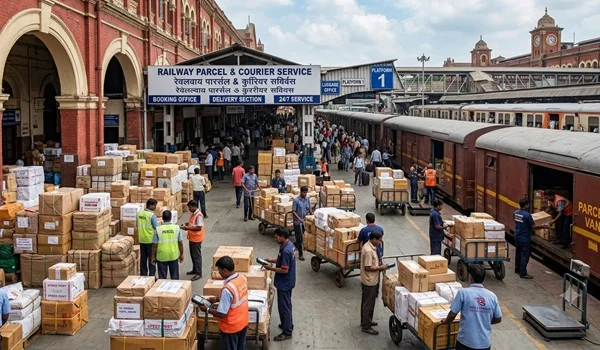
Railway parcel business involves sending permitted goods and consignments through Indian Railways’ parcel system.
Passengers and businesses can book eligible articles as railway parcels, subject to applicable rules, packing requirements, charges and acceptance conditions.
The railway parcel process can involve:
- Booking
- Weighment
- Documentation
- Labelling
- Charging
- Loading
- Transportation
- Unloading
- Delivery
Indian Railways’ training material explains that the consignor has to provide a forwarding note, parcels are weighed, the applicable freight is collected and a Railway Receipt is issued as the relevant transport document.
Railway Parcel vs Courier Business
These two models are often confused.
| Factor | Railway Parcel | Private Courier |
| Transport Network | Indian Railways | Private logistics network |
| Booking | Railway parcel office/system | Courier company |
| Main Customers | Businesses and passengers | Individuals and businesses |
| Pricing | Railway tariff/conditions | Company pricing |
| Delivery | Railway network + delivery arrangements | Door-to-door network |
| Railway Permission | Needed for railway premises/services | Needed if operating on railway premises |
| Tracking | Railway system/process | Courier company’s system |
A business can potentially use both models by operating a private logistics/collection service while using railway parcel facilities for eligible consignments, but the arrangements and permissions must be clearly separated.
- Railway Parcel Booking Service
The most direct opportunity is helping customers understand and use railway parcel services.
A parcel customer may need to transport:
- Commercial goods
- Machinery
- Household articles
- Bicycles
- Two-wheelers
- Agricultural products
- Other permitted articles
The railway accepts parcels according to its rules and applicable tariffs.
Parcel rates are determined according to factors such as the type of article, weight, distance and applicable scale. Indian Railways publishes parcel rate tables for different distance ranges.
- Parcel Collection Service
A collection service can solve one of the biggest problems for business customers: getting goods from their premises to the railway parcel office.
Indian Railways’ Commercial Manual provides for collection services operated by authorised contractors, under which packages can be collected from consignors’ premises and taken to the serving railway station for booking and onward dispatch.
This is an important business opportunity because the customer does not necessarily have to arrange transportation to the station themselves.
However, where the service is being offered as an official railway collection service, it must operate under the applicable railway authorisation and agreement.
- Parcel Packing Business
Packing is another opportunity around railway stations.
Businesses sending goods by rail may need appropriate packaging to protect articles during handling and transportation.
A packing service can potentially offer:
- Carton packing
- Bubble wrapping
- Wooden packing
- Strapping
- Protective packaging
- Labelling
- Handling support
The packaging must meet the requirements applicable to the particular type of parcel.
Railway instructions specifically state that parcels need to be properly packed and that deficiencies in packing can be recorded on the forwarding documentation.
- Courier Collection Centre Near Railway Station
A private courier collection centre can be established near a busy railway station.
Instead of operating inside railway premises, the business can function from a private shop and provide services such as:
- Courier booking
- Parcel collection
- Packing
- Shipment preparation
- Local delivery
- E-commerce parcel handling
The business can target passengers as well as nearby shops and offices.
This model generally provides more flexibility than trying to operate directly inside railway premises.
- E-Commerce Parcel Handling
Online shopping has created large volumes of small parcels.
A logistics business near a railway station can potentially serve:
- Online sellers
- Small manufacturers
- Retailers
- Local businesses
- Home businesses
- E-commerce merchants
Services can include:
- Packing
- Shipment booking
- Pickup
- Storage
- Dispatch coordination
The railway station can serve as a strategic transportation point, but the private courier company will still need to follow its own contractual and regulatory requirements.
- Business Logistics Centre
A larger logistics operation can use railway connectivity as one part of its transportation network.
For example, a business can combine:
Local pickup → Railway transportation → Local delivery
This can be useful for companies moving goods between cities.
The business does not necessarily have to operate from inside the station. A warehouse or logistics office near the station can handle collection and last-mile delivery.
- Railway Parcel Van Leasing
For larger logistics operators, Indian Railways provides opportunities related to leasing parcel space.
Under the comprehensive parcel leasing policy, parcel space in Parcel Vans can be leased through open tenders, generally for long-term contracts. The policy applies to Parcel Vans attached to eligible trains and Parcel Express arrangements, subject to its conditions.
This is a much larger opportunity than ordinary parcel booking.
It may be suitable for:
- Logistics companies
- Transport companies
- E-commerce operators
- Large traders
- Freight businesses
The financial and operational requirements are considerably greater than those of a small parcel shop.
- Parcel Express and Dedicated Logistics
Indian Railways also has arrangements for dedicated parcel transportation.
The parcel leasing framework covers Parcel Cargo Express Train-related arrangements and leasing of parcel capacity. Railway training and commercial documents also identify Parcel Cargo Express Trains and the Parcel Management System as important parts of parcel operations.
This segment is more appropriate for established logistics operators rather than first-time entrepreneurs.
- Two-Wheeler and Vehicle Parcel Services
Railway parcel services can also handle certain vehicles and other large articles subject to railway conditions.
For example, passengers may need to transport a motorcycle or scooter to another city.
Such bookings involve specific documentation, packing/handling requirements and applicable charges.
A business can potentially provide packing and preparation assistance around these shipments, while the actual railway transportation remains subject to railway rules.
- Courier Franchise Near Railway Station
Another way to enter this sector is through a courier or logistics franchise.
The basic model is:
Courier Brand → Franchise/Agency → Local Customers
The outlet can serve:
- Individuals
- Small businesses
- Online sellers
- Offices
- Students
- Traders
A railway station location can be useful because passengers and local businesses may need parcel services.
However, a courier franchise does not automatically receive permission to operate inside railway premises. Railway property and access are subject to separate rules.
How Does a Railway Parcel Business Make Money?
There are several possible revenue models.
Parcel Booking Assistance
A business may earn according to its authorised service or agency arrangement.
Collection Charges
An authorised collection operator can charge customers for collecting packages from their premises, subject to the applicable agreement.
Packing Charges
Customers can pay separately for packaging.
Local Delivery
A private logistics operator can charge for moving parcels between the railway station and the customer’s address.
Warehousing
A business may offer short-term storage from a private facility.
Parcel Van Leasing
Larger operators can earn from using leased parcel capacity to move commercial consignments.
Example of a Private Parcel Business Revenue Model
Suppose a private logistics centre near a railway station handles:
- 80 parcels per day
- Average packing/service revenue of ₹75 per parcel
Daily service revenue:
80 × ₹75 = ₹6,000
Monthly revenue at 30 days:
₹6,000 × 30 = ₹1,80,000
This is only a hypothetical example.
The business would still have to pay for:
- Packaging materials
- Staff
- Rent
- Local transportation
- Electricity
- Courier/logistics partner charges
- Taxes
- Insurance where applicable
- Other operating expenses
Therefore, gross revenue should not be confused with profit.
Railway Parcel Business Investment
There is no fixed investment amount.
The investment changes dramatically depending on the business model.
Small Parcel and Courier Shop
Main expenses may include:
- Shop rent
- Counter
- Computer
- Printer
- Weighing machine
- Packaging material
- Furniture
- Internet
- Staff
- Working capital
Packing and Collection Business
Additional expenses may include:
- Delivery vehicle
- Packing equipment
- Storage racks
- Labour
- Fuel
- Insurance
Parcel Logistics Company
A larger setup may require:
- Warehouse
- Multiple vehicles
- Staff
- Technology
- Sorting equipment
- Security
- Working capital
Parcel Van Leasing
This is a substantially larger commercial opportunity and requires tender participation and the financial capacity to meet the contract terms. Indian Railways’ parcel leasing policy specifies that Parcel Van space is offered through open tenders and is not intended for short-term, day-to-day leasing.
Requirements for Railway Parcel Business
Requirements depend on what exactly you want to do.
For Railway Parcel Booking
Customers generally need to comply with railway parcel booking requirements, including proper declaration, packing and documentation.
Indian Railways’ parcel procedures involve a forwarding note and railway documentation for the consignment.
For a Private Courier Shop
You may need to consider:
- Business registration
- PAN
- GST where applicable
- Local shop/trade requirements
- Courier company agreement, if operating as an agent/franchise
- Appropriate weighing and billing systems
- Packaging arrangements
For Railway Premises
Additional railway permission or an authorised commercial contract may be required.
For Collection Services
Official railway collection services are governed by specific contractor agreements. The Commercial Manual states that authorised collection contractors can collect consignments from customers and carry them to the relevant station for booking.
Digitalisation of Railway Parcel Services
Railway parcel operations are becoming more technology-driven.
In 2024, South Central Railway introduced QR-code payment at 35 major parcel offices, integrated with the Parcel Management System (PMS). The system allows customers to pay railway parcel charges through UPI by scanning a transaction-specific QR code.
Railway Board also announced online indenting for Parcel Vans through the Freight Business Development portal, with the online process implemented from July 2025 for specified Parcel Van arrangements.
This means entrepreneurs entering the logistics segment should be prepared for digital documentation, online processes and cashless payments.
How to Start a Parcel & Courier Business Near a Railway Station
Step 1: Choose Your Business Model
Decide whether you want to operate:
- Courier shop
- Parcel packing centre
- Parcel collection service
- Local delivery service
- E-commerce logistics centre
- Railway parcel-related contractor
- Larger parcel logistics operation
Step 2: Decide Whether You Need Railway Premises
A private shop near the railway station can provide more flexibility.
Operating inside the railway premises may require additional railway permission, tender or contract.
Step 3: Study Local Demand
Check:
- Railway passenger footfall
- Nearby markets
- Industrial areas
- Wholesale markets
- E-commerce sellers
- Small businesses
- Colleges and offices
Step 4: Build Courier Partnerships
If operating a private courier centre, partnerships with established logistics companies can help provide nationwide delivery coverage.
Step 5: Add Packing Services
Packing can create an additional revenue stream and increase customer convenience.
Step 6: Offer Local Pickup and Delivery
A local vehicle can collect parcels from nearby homes and businesses and take them to the appropriate dispatch point.
Parcel Business Inside vs Near Railway Station
| Factor | Inside Railway Station | Near Railway Station |
| Railway Permission | Generally required | Not for private premises |
| Passenger Access | Very high | Depends on location |
| Business Flexibility | Limited by contract | Greater |
| Rent/Property | Railway commercial terms | Market-based |
| Operating Rules | Railway-specific | General/local requirements |
| Courier Partnerships | Possible depending on permission | Easier to structure |
| Product/Service Range | Contract-dependent | More flexible |
For most beginners, a private parcel and courier centre near a railway station may be easier to operate than trying to obtain a commercial space inside the station.
How to Make the Business Successful
Target Local Businesses
Do not depend entirely on railway passengers.
Approach:
- E-commerce sellers
- Traders
- Retailers
- Manufacturers
- Offices
- Students
- Medical suppliers
- Local wholesalers
Offer Complete Services
Instead of only booking parcels, consider a combination of:
Packing + Pickup + Booking + Local Delivery
This can increase revenue per customer.
Use Digital Payments
UPI payments can make transactions faster and easier.
Maintain Accurate Weight
Weigh every parcel properly and maintain clear records.
Provide Tracking
Customers want visibility over their shipments.
Protect Customer Goods
Proper packing, handling and storage reduce disputes and damage.
Common Challenges
Competition
National courier companies and local logistics providers can compete aggressively.
Low Margins
Courier businesses often depend on volume rather than very high margins per shipment.
Vehicle Costs
Pickup and delivery can become expensive if routes are poorly planned.
Railway Rules
Businesses using railway parcel services have to follow applicable booking and handling rules.
Restricted Goods
Not every product can be transported through every service. Operators must understand prohibited and restricted articles.
Claims and Damage
Incorrect packing or mishandling can lead to customer disputes and claims.
Railway Parcel Business vs Courier Business
A railway parcel business primarily uses railway transportation, whereas a courier company normally focuses on door-to-door logistics.
For a small entrepreneur, combining the two can be attractive:
Customer → Your Collection Centre → Suitable Transport → Destination Delivery
The railway network can become one transportation option within that larger logistics chain.
Is Railway Parcel & Courier Business Profitable?
It can be profitable, but the business depends heavily on shipment volume, pricing and operating efficiency.
A business with 20 shipments per day may struggle to cover rent and staff costs, while one handling hundreds of shipments may achieve much better economics.
The important calculation is:
Total Shipment Revenue
minus
Courier/rail freight + staff + rent + vehicles + packing + taxes + other expenses
equals
Operating Profit
Before opening the business, calculate the minimum number of parcels you need every day to reach break-even.
Final Thoughts
Railway station parcel and courier businesses can offer several opportunities, ranging from a small packing and courier shop to larger logistics operations and railway Parcel Van leasing.
The best option depends on your capital, experience and willingness to work within railway rules.
For beginners, a private courier and parcel centre near a busy railway station can be a practical starting point. Services such as packaging, local pickup, courier booking and last-mile delivery can create multiple revenue streams.
Established logistics companies can explore more advanced opportunities such as authorised railway collection services and Parcel Van leasing. Indian Railways’ current parcel systems increasingly use digital booking and payment mechanisms, making technology and proper documentation increasingly important.
Before investing, always verify the current railway tender, parcel rules, permitted articles, applicable charges and contractual requirements.
FAQs
Can I start a parcel business inside a railway station?
Not simply by renting or occupying a space. Businesses operating inside railway premises may require the relevant railway licence, tender, contract or other authorisation.
Can I start a courier shop near a railway station?
Yes, a private courier or logistics shop can be established on private premises, subject to applicable business, tax, local and courier-company requirements.
What services can a railway parcel business offer?
Depending on the model, services can include parcel booking, packing, collection, loading support, local transportation and delivery coordination.
How much investment is required?
There is no fixed amount. A small courier centre can have relatively limited infrastructure requirements, while a warehouse, collection network or Parcel Van operation requires substantially more capital.
Can private businesses collect parcels from customers for railway booking?
Indian Railways’ Commercial Manual provides for authorised collection services under which contractors can collect consignments from customers and take them to railway stations for booking. Such services operate under the applicable railway agreement and conditions.
Can I lease railway Parcel Van space?
Yes, Indian Railways has a parcel leasing framework under which eligible Parcel Van space can be offered through open tenders. Such contracts are designed for larger parcel/logistics operations and are subject to detailed eligibility and contractual conditions.