Railway stations offer many commercial opportunities for entrepreneurs, contractors and service providers. These opportunities can include catering, food stalls, food plazas, parking, advertising, retiring rooms, housekeeping, maintenance, parcel-related services and other station facilities.
Unlike a normal private business, railway-related opportunities are usually awarded through a tender, e-tender, e-auction, licence, contract or empanelment process. The exact method depends on the type of work and the organisation issuing the tender.
Current 2026 government listings show IRCTC publishing opportunities for refreshment rooms, Jan Aahaar, fast-food units, food plazas, retiring-room operations and other services. Some are specifically structured as open e-tender cum e-auction opportunities.
This guide explains the major types of railway tender businesses, how the tender process works, what documents may be required and how beginners can approach this sector.
Quick Information
| Factor | Details |
| Business Type | Railway commercial contract/tender |
| Main Opportunities | Catering, parking, advertising, maintenance, parcel and station services |
| Entry Method | E-tender, e-auction, licence, contract or empanelment |
| Main Platforms | Government e-procurement and relevant railway/IRCTC portals |
| Key Financial Requirements | Tender fee, EMD, security/performance requirements |
| Main Customers | Passengers, railway organisations, brands or businesses |
| Major Advantage | Large and recurring railway-related demand |
| Major Challenge | Strict eligibility and contract conditions |
| Best Approach | Study tender before bidding |
What Is a Railway Tender Business?
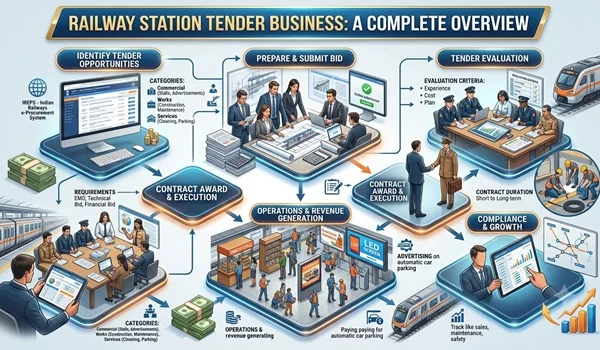
A railway tender business is a business opportunity where a railway organisation invites qualified parties to provide a service, operate a facility, supply goods or manage a commercial activity.
Instead of simply opening a business, the entrepreneur competes for a contract.
The basic model is:
Railway/IRCTC → Tender Notice → Eligible Bidders → Bid Evaluation → Contract Award → Business Operation
The successful bidder then operates according to the terms stated in the contract.
Types of Railway Station Tender Businesses
There is no single category of railway tender business. Opportunities can range from small service contracts to large multi-year commercial projects.
- Railway Catering Tenders
Catering is one of the biggest commercial categories.
Possible opportunities include:
- Tea and catering stalls
- Fast-food units
- Food plazas
- Refreshment rooms
- Jan Aahaar
- Other catering services
Current 2026 IRCTC tender listings include open e-tender cum e-auction opportunities for Fast Food Units, Food Plazas, Refreshment Rooms and Jan Aahaar at railway stations.
These tenders can be suitable for food businesses, restaurant operators and experienced catering companies.
- Railway Station Parking Tenders
Parking is another established commercial category.
A contractor may receive the right to operate:
- Two-wheeler parking
- Car parking
- Commercial-vehicle parking
- Taxi/auto arrangements
- Other designated parking facilities
The contractor collects applicable parking charges and manages the parking area according to the contract.
This model can be attractive because revenue comes from repeated passenger transactions.
- Railway Advertising Tenders
Railway stations provide advertising opportunities through:
- Hoardings
- Digital screens
- LED displays
- Platform branding
- Wall advertising
- Station branding
- Other authorised media assets
An advertising company can participate directly in relevant commercial opportunities or work as a media agency for an existing authorised operator.
The financial structure depends on the inventory, station, contract period and advertising rights.
- Railway Retiring Room Tenders
Accommodation-related opportunities can also be tendered.
Current 2026 government listings show an IRCTC e-tender for renovation, operation, maintenance and transfer back of retiring rooms at Tenkasi railway stations.
This type of contract is different from simply opening a private hotel near a station.
The contractor may be responsible for:
- Renovation
- Operations
- Housekeeping
- Maintenance
- Customer service
- Transfer back at the end of the contract
The exact obligations are determined by the tender document.
- Housekeeping and Facility Management
Railway and railway-related organisations also issue service contracts for:
- Cleaning
- Housekeeping
- Facility management
- Maintenance
- Pest control
- Security-related support
- Other station services
Current 2026 IRCTC listings include empanelment opportunities for service providers involved in catering, housekeeping and facility management under non-railway catering services.
These opportunities can suit companies that specialise in manpower and facility management.
- Railway Parcel and Logistics Tenders
Parcel-related opportunities can include:
- Parcel handling
- Collection services
- Logistics support
- Packing
- Transportation
- Parcel-space leasing
Larger logistics companies may also explore railway parcel leasing opportunities where available.
This category requires a better understanding of railway parcel procedures, documentation, handling and transportation requirements.
- Supply and Vendor Empanelment
Not every railway business opportunity is about operating a station facility.
Some are for supplying products.
Current 2026 IRCTC listings include empanelment opportunities for suppliers of items such as:
- Bakery products
- Biscuits
- Coffee
- Tea
- Namkeen
- Fruit juice
- Popcorn
- Nuts/dry fruits
- Other permitted food products.
This can be an interesting option for manufacturers, wholesalers and food suppliers.
- Maintenance and Engineering Contracts
Railway organisations also need contractors for technical and infrastructure-related work.
Depending on the organisation and tender, opportunities can include:
- Electrical work
- Civil maintenance
- Plumbing
- Signage
- Telecom
- IT systems
- Equipment maintenance
- Building maintenance
These tenders may require technical qualifications and previous experience, so they are generally more suitable for specialised companies.
Tender vs Auction vs Empanelment
These terms are important because they describe different ways of entering railway business.
| Process | Basic Meaning |
| E-Tender | Bid submitted electronically against tender conditions |
| E-Auction | Eligible bidders compete financially through an online auction |
| E-Tender Cum E-Auction | Tender qualification followed by an auction/financial competition |
| Licence | Permission to operate a defined activity for a period |
| Empanelment | Becoming an approved/eligible supplier or service provider |
| Service Contract | Agreement to provide a defined service |
For example, current IRCTC catering opportunities use the e-tender cum e-auction model.
Therefore, entrepreneurs should not assume that every railway opportunity follows the same bidding process.
How to Find Railway Tenders
One of the first challenges for beginners is finding the correct tender.
Useful sources include:
Government e-Procurement Portal
The Government of India’s ePublishing system publishes tender notices from Central Government organisations and allows users to view tender enquiries, corrigenda and contract-award information.
Railway Websites
Check the relevant:
- Railway zone
- Railway division
- Railway Board
- Commercial department
IRCTC
For catering, tourism, accommodation and related services, IRCTC publishes its own commercial opportunities.
Current listings show multiple 2026 IRCTC station-related tenders on the government e-procurement system.
How to Apply for a Railway Tender
The basic process is usually as follows.
Step 1: Identify the Right Tender
Search by business category instead of randomly looking for railway tenders.
For example:
Parking + Railway
Catering + Railway Station
Fast Food Unit + IRCTC
Housekeeping + Railway
Advertising + Railway
This helps you find opportunities relevant to your capabilities.
Step 2: Read the Tender Notice
First check:
- Tender title
- Organisation
- Tender ID
- Issue date
- Closing date
- Opening date
- Estimated value
- Contract period
The current government e-procurement listing shows these details alongside each IRCTC opportunity.
Step 3: Download the Complete Tender Document
Do not make a decision based only on the summary page.
Read all schedules, annexures and technical conditions.
Look for:
- Eligibility
- Work scope
- Financial criteria
- Experience
- EMD
- Tender fee
- Security deposit
- Performance guarantee
- Payment terms
- Penalties
- Contract period
- Termination clauses
Step 4: Check Eligibility Before Paying Anything
This is one of the most important steps.
A tender may require:
- Minimum turnover
- Previous experience
- Specific certifications
- Company registration
- Technical qualifications
- Financial capacity
- GST/PAN
- Similar-work experience
If you do not qualify, submitting the bid can waste time and money.
Step 5: Arrange the Required Documents
Common documents may include:
- PAN
- GST registration, where applicable
- Company/firm registration
- Address proof
- Bank details
- Financial statements
- Income-tax returns
- Experience certificates
- Work-completion certificates
- EMD proof
- Affidavits and declarations
The exact list depends entirely on the tender.
Step 6: Arrange EMD and Tender Fee
EMD
Earnest Money Deposit is submitted to demonstrate seriousness and protect the tendering authority against certain bidding defaults.
Tender Fee
Some tenders may also charge a tender/document fee.
The amount and payment method must be taken from the individual tender.
Step 7: Submit the Technical Bid
The technical bid typically establishes that you qualify.
This can involve:
- Experience
- Turnover
- Qualifications
- Certifications
- Documents
- Declarations
A technically non-compliant bid may not proceed to financial evaluation.
Step 8: Submit the Financial Bid
The financial bid contains your commercial offer.
Depending on the type of contract, this could mean:
- Quoted contract amount
- Licence fee
- Revenue share
- Service rate
- Auction price
- Other specified financial terms
Do not quote an amount before calculating your actual business costs.
Step 9: Participate in Auction if Applicable
For e-tender cum e-auction opportunities, eligible bidders may move to an electronic auction stage.
Current IRCTC listings explicitly use this format for certain station catering contracts.
The auction rules, increment values, number of rounds and qualifying bidders are defined by the tender.
Step 10: Contract Award
After the evaluation process, the successful bidder receives the applicable award communication.
The bidder may then need to:
- Pay security/performance amounts
- Sign the agreement
- Submit additional documents
- Complete registrations
- Take possession/handover
- Begin operations
Railway Tender Investment
There is no fixed investment for a railway tender business.
Your financial requirement depends on the contract type.
Small Business Opportunity
Examples:
- Small service contract
- Limited retail opportunity
- Small supply order
Medium Opportunity
Examples:
- Catering outlet
- Parking contract
- Housekeeping contract
- Small logistics operation
Large Opportunity
Examples:
- Food plaza
- Large facility-management contract
- Parcel leasing
- Major infrastructure work
- Multi-location service contract
A contractor should calculate not just the bid amount, but also the total working capital needed to operate the contract.
Railway Tender Business Model
A simple commercial formula is:
Contract Revenue – Operating Costs – Contractual Payments – Taxes = Business Profit
Depending on the tender, revenue may come from:
- Passenger payments
- Product sales
- Service fees
- Advertising clients
- Parking charges
- Railway payments
- Supply contracts
The revenue model is therefore different for every tender category.
Example: Catering Tender
Suppose a hypothetical food outlet generates:
₹7 lakh monthly sales
Operating costs:
- Food ingredients: ₹2.5 lakh
- Staff: ₹1.2 lakh
- Utilities: ₹30,000
- Contract/licence allocation: ₹1.5 lakh
- Other expenses: ₹50,000
Estimated operating surplus:
₹1 lakh per month
This is only an illustrative calculation.
Actual revenue, costs and margins depend on the specific station and contract.
Example: Service Contract
Suppose a contractor receives:
₹20 lakh annual contract revenue
Annual operating costs:
- Staff: ₹9 lakh
- Equipment: ₹2 lakh
- Transport: ₹1.5 lakh
- Administration: ₹1 lakh
- Other expenses: ₹1 lakh
Estimated operating surplus:
₹5.5 lakh
Again, actual numbers will depend on the tender.
Why Railway Tender Businesses Can Be Attractive
Established Market
The railway network has recurring requirements for passenger and operational services.
Contract-Based Revenue
A successful contractor receives business under a defined agreement.
Large Customer Base
Commercial businesses such as catering and parking can benefit from passenger traffic.
Multiple Categories
Entrepreneurs can choose between service, supply and commercial-operation opportunities.
Expansion Potential
Experienced contractors can bid for multiple contracts over time.
Major Risks
Overbidding
Winning a tender at an excessively high price can destroy margins.
Working Capital Shortage
You may need to spend money on salaries, stock, equipment and operations before revenue becomes stable.
Strict Compliance
Railway contracts can have detailed service standards.
Penalties
Poor performance can result in deductions, penalties or other contractual consequences.
Contract Termination
Serious non-compliance can have substantial business consequences.
Changing Tender Conditions
Future opportunities may not have the same eligibility or commercial terms as earlier tenders.
How Beginners Can Enter Railway Tender Business
A beginner should not necessarily start with the largest tender.
A better strategy can be:
Start With Your Existing Skill
If you run a restaurant, look for catering.
If you operate a cleaning company, look for housekeeping.
If you own a logistics business, look for parcel/logistics opportunities.
If you manufacture products, look for supplier/empanelment opportunities.
Build Experience
Successful contracts can help establish experience for future opportunities where similar-work experience is required.
Improve Documentation
Maintain:
- GST records
- Tax returns
- Financial statements
- Completion certificates
- Work orders
- Client references
Good documentation becomes valuable when a future tender asks for proof of experience.
Common Mistakes in Railway Tender Business
Applying Without Reading the Tender
The summary page is not enough.
Ignoring Corrigenda
A tender can be modified after publication.
Always check whether amendments or corrigenda have been issued.
Bidding Emotionally
Do not increase your bid simply because competitors are bidding aggressively.
Underestimating Working Capital
A profitable contract can still create cash-flow problems if expenses need to be paid before collections.
Using Generic Information
Railway policies differ by organisation, department, station and contract type.
The specific current tender document should take priority.
Important Difference: Railway Business Tender vs Railway Job
A railway tender business is completely different from a railway government job.
A tender allows a private individual, firm or company to provide goods or services under a commercial contract.
It does not make the successful bidder a railway employee.
This distinction is important when planning investments and staffing.
Is Railway Tender Business Profitable?
It can be, but profitability depends on the contract economics, not simply on winning the tender.
Before bidding, calculate:
Expected Revenue
minus
Bid/Contract Cost + Staff + Equipment + Materials + Working Capital + Taxes + Other Costs
Then determine your expected profit.
Your bid should be based on this calculation.
A contract that looks attractive on paper can become loss-making if:
- You overbid
- Labour costs increase
- Revenue is lower than expected
- Material prices rise
- Penalties reduce collections
- Working capital becomes expensive
Final Thoughts
Railway tender business offers opportunities across a wide range of sectors, from food stalls and food plazas to parking, advertising, retiring rooms, housekeeping, logistics and supply contracts.
The most important thing is to choose a tender that matches your experience, financial capacity and operational skills.
The process usually involves:
Find Tender → Check Eligibility → Read Documents → Arrange EMD → Submit Technical Bid → Submit Financial Bid → E-Auction if Applicable → Contract Award → Start Operations
Current 2026 listings demonstrate that railway-related tenders are active across multiple categories, including catering, accommodation, service-provider empanelment and other commercial activities.
For beginners, the safest approach is not to chase the biggest tender. Start with an opportunity where you understand the work, can meet all eligibility conditions and can comfortably fund the operation throughout the contract period.
Always verify the latest tender notice, corrigenda, eligibility criteria, financial requirements and submission process before paying any fee or placing a bid.
FAQs
What types of railway tender businesses are available?
Common categories include catering, food plazas, fast-food units, parking, advertising, retiring rooms, housekeeping, facility management, logistics, supply contracts and other railway services.
How can I apply for a railway tender?
Find a relevant tender on the official government e-procurement system or the relevant railway/IRCTC platform, check eligibility, prepare the required documents, pay the applicable EMD/tender fee and submit the bid electronically according to the tender instructions.
Do I need a company to apply for a railway tender?
Not always. Eligibility depends on the tender. Some opportunities may permit individuals, proprietorships, partnerships or companies, while others may require a specific business structure or experience.
What is EMD in a railway tender?
EMD stands for Earnest Money Deposit. It is a bid-related security amount specified in the tender to demonstrate financial commitment and protect the tendering process against certain bidder defaults.
What is e-tender cum e-auction?
It combines a tender qualification process with an online auction stage for eligible bidders. Current IRCTC station-catering opportunities use this model for categories such as Fast Food Units, Food Plazas, Refreshment Rooms and Jan Aahaar.
Where can I find current railway tenders?
The Government of India’s Central Public Procurement/ePublishing system publishes tender notices and related information, while relevant railway zones, divisions and IRCTC also publish their own opportunities.