Railway stations can be attractive locations for franchise businesses because they bring together a large number of passengers, visitors, commuters and railway staff. A well-known brand can benefit from this traffic while passengers get a familiar product or service.
However, starting a franchise inside a railway station is different from taking a normal franchise in a shopping market. A franchise agreement with a brand does not automatically give you the right to use railway premises. The entrepreneur may need a separate railway licence, tender, allotment or authorised commercial arrangement for the specific station space.
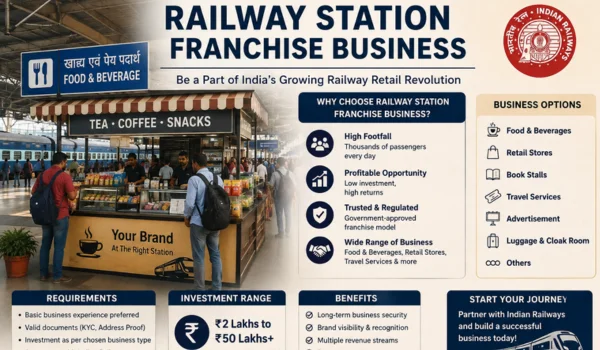
Railway commercial opportunities currently include food outlets, catering units, retail stalls and other passenger-oriented services. Current 2026 IRCTC listings, for example, include opportunities involving Fast Food Units, Food Plazas, Refreshment Rooms and Jan Aahaar.
Quick Information
| Factor | Details |
| Business Type | Franchise outlet at or near railway station |
| Main Customers | Passengers, commuters, visitors |
| Best Categories | Food, beverages, bakery, convenience retail, travel services |
| Business Location | Station premises or nearby private property |
| Railway Permission | Required for railway premises |
| Main Investment | Franchise + premises + equipment + working capital |
| Revenue Source | Product/service sales |
| Main Advantage | Brand recognition + passenger traffic |
| Major Challenge | Franchise and railway commercial costs |
| Best Approach | Verify franchise and railway permissions separately |
What Is a Railway Station Franchise Business?
A railway station franchise business involves operating a branded outlet that serves passengers or visitors at or near a railway station.
For example, an entrepreneur might operate a:
- Café
- Fast-food outlet
- Bakery
- Beverage counter
- Convenience store
- Travel service
- Branded retail kiosk
The business model generally works like this:
Franchisor → Franchise Agreement → Entrepreneur → Railway Commercial Space/Permission → Outlet Operations
The important point is that there are two separate relationships:
Brand relationship: Franchise agreement
Railway relationship: Space/licence/tender/authorisation
You may need both before opening the outlet inside railway premises.
Why Franchises Can Work at Railway Stations
Passengers often prefer familiar brands, especially when they have limited time.
A branded outlet may provide:
- Recognisable products
- Standardised quality
- Faster ordering
- Familiar pricing
- Established packaging
- Customer trust
This can be particularly useful for travellers who do not know the local market.
However, the franchise should match the nature of railway passengers. A business that requires customers to spend a long time inside the outlet may not work as well as a quick-service concept.
Best Railway Station Franchise Categories
- Fast-Food Franchise
Fast food is one of the most natural franchise categories for railway stations.
Passengers often want something that can be ordered and consumed quickly.
Potential formats include:
- Burgers
- Sandwiches
- Wraps
- Pizza
- South Indian food
- Snacks
- Quick meals
IRCTC’s current commercial opportunities include Fast Food Units at railway stations, demonstrating that quick-service food is an established railway commercial category.
Why It Can Work
- Quick service
- High passenger demand
- Easy-to-understand menu
- Strong brand potential
- Takeaway-friendly products
The main challenge is managing food cost, staffing and railway commercial charges.
- Café Franchise
A café can work particularly well at stations where passengers have longer waiting times.
A café may sell:
- Tea
- Coffee
- Cold beverages
- Sandwiches
- Bakery products
- Desserts
- Light meals
Best Locations
Café franchises can be more suitable near:
- Waiting halls
- Station concourses
- Major entrances
- Premium passenger areas
- Large junctions
A very small station with quick passenger turnover may not provide the same opportunity as a major railway terminal.
- Tea and Beverage Franchise
A tea, coffee or beverage franchise can be a relatively simple format.
The outlet can focus on:
- Tea
- Coffee
- Packaged beverages
- Cold drinks
- Quick snacks
The major advantage is high-frequency, low-ticket purchasing.
Passengers may not buy a full meal, but many are willing to buy a cup of tea or coffee.
- Bakery Franchise
Bakery products are highly suitable for travel because they are easy to carry.
Possible products include:
- Cakes
- Pastries
- Cookies
- Muffins
- Puffs
- Bread
- Sandwiches
A bakery can also combine takeaway and quick-service concepts.
Why It Can Work
Passengers often purchase food to eat:
- At the station
- On the train
- After reaching their destination
This gives bakery products a wider use case than dine-in food.
- Convenience Retail Franchise
A convenience franchise can focus on products passengers need during travel.
Potential categories include:
- Packaged snacks
- Water
- Beverages
- Personal-care products
- Tissues
- Travel essentials
- Other permitted convenience items
This model can work because it solves immediate passenger needs.
However, the products allowed in a railway retail outlet depend on the applicable licence and commercial category.
- Travel Accessories Franchise
A travel-focused retail outlet can sell products such as:
- Luggage locks
- Travel pillows
- Bags
- Pouches
- Charging accessories
- Umbrellas
- Luggage tags
- Travel organisers
These are particularly relevant because passengers frequently discover forgotten travel items after reaching the station.
- Mobile Accessories Franchise
Smartphones are essential for almost every modern traveller.
A mobile-accessories kiosk could sell:
- Chargers
- Cables
- Earphones
- Power banks
- Phone covers
- Screen protectors
This category can work well because customers sometimes make urgent purchases.
However, the exact suitability depends on railway commercial rules and whether a stall licence permits the sale of these items.
- Food Plaza or Multi-Brand Food Franchise
A larger entrepreneur can consider a food-plaza-style concept.
IRCTC’s tender documents define Food Plazas as establishments offering multiple cuisines under one roof, generally with a common kitchen.
This can potentially accommodate:
- Indian food
- South Indian food
- Fast food
- Beverages
- Desserts
A larger format requires more:
- Capital
- Staff
- Equipment
- Working capital
- Operational experience
It is therefore generally more suitable for established food operators than first-time entrepreneurs.
- Restaurant Franchise
A full restaurant franchise can serve passengers who have enough time for a proper meal.
It may target:
- Families
- Long-distance passengers
- Tourists
- Business travellers
- Passengers waiting for connecting trains
A restaurant can offer a higher average order value than a tea or snack outlet, but it also has greater operating costs.
- Local Food Franchise
Railway passengers often want to experience local cuisine.
A regional-food franchise can combine a recognised brand with local food preferences.
For example, a franchise may focus on:
- Regional snacks
- Traditional breakfast
- Local sweets
- Vegetarian regional cuisine
This can be especially attractive in tourist cities and pilgrimage destinations.
- Book and Reading Retail Franchise
A book-related business can target long-distance passengers.
Products may include:
- Newspapers
- Magazines
- Novels
- Children’s books
- Competitive-exam books
- Travel guides
Indian Railways has historically provided dedicated bookstall opportunities. Railway statistics for 2023–24 recorded bookstalls among station commercial units.
The challenge is that digital reading has changed customer behaviour, so product selection and location are important.
- Pharmacy Franchise
A pharmacy can address passenger healthcare needs.
A suitable outlet could stock permitted medicines and healthcare products, subject to applicable drug regulations.
However, pharmacy is a highly regulated franchise category.
The entrepreneur may need:
- Drug licence
- Registered pharmacist
- Appropriate premises
- Railway commercial permission
- Compliance with storage and dispensing rules
Railway statistics have included dedicated chemist stalls at stations, indicating that this category can exist within railway commercial infrastructure.
- Juice and Healthy Food Franchise
Health-oriented food businesses can also target railway passengers.
Possible products include:
- Fresh juices
- Packaged juices
- Fruit
- Light meals
- Salads
- Healthy snacks
This may work particularly well in metropolitan stations and premium passenger areas.
Food safety and permitted product categories must be checked before operation.
- Ice Cream and Dessert Franchise
An ice-cream or dessert franchise can generate impulse purchases.
It may be suitable near:
- Family waiting areas
- Large platforms
- Major station entrances
- Tourist destinations
The main challenge is that demand can be seasonal and refrigeration requirements can increase operating costs.
- Travel Service Franchise
Not all railway station franchises need to sell physical products.
A travel-service franchise could provide services such as:
- Hotel booking
- Local transport
- Tour packages
- Travel assistance
- Tourist information
This can be particularly useful at stations serving popular tourist destinations.
However, travel services should be properly authorised and should clearly distinguish private services from official railway services.
Franchise vs Independent Railway Shop
Before choosing a franchise, compare it with an independent railway business.
| Factor | Franchise | Independent Shop |
| Brand | Established | Self-created |
| Customer Trust | Potentially higher | Must be built |
| Franchise Fee | May apply | No franchise fee |
| Royalty | May apply | Usually none |
| Menu/Product Control | Restricted | Greater |
| Marketing | Brand support | Self-managed |
| Railway Permission | Still required | Still required |
| Profit Sharing | May involve royalty | More control |
| Training | Often provided | Self-managed |
A franchise reduces some brand-building challenges, but it also reduces flexibility and can add fees.
Railway Permission Is Separate From Franchise Permission
This is the most important point for entrepreneurs.
Suppose a business purchases a café franchise.
That does not automatically mean the franchisee can occupy a railway station shop.
The entrepreneur may have to separately obtain:
- Railway stall licence
- Commercial space allotment
- Tender/contract
- Station-specific authorisation
Current railway commercial tenders demonstrate that specific station spaces and catering units are separately offered through authorised processes.
Therefore, before paying a franchise fee, ask the franchisor:
Does the brand already have authorised railway locations, or will I have to obtain the railway space myself?
This can significantly change the investment and feasibility of the business.
How to Start a Railway Station Franchise
Step 1: Select the Franchise Category
Choose according to:
- Passenger demand
- Investment capacity
- Your experience
- Station profile
Step 2: Research Franchise Brands
Compare:
- Franchise fee
- Royalty
- Minimum investment
- Agreement period
- Product margin
- Training
- Supply chain
- Marketing support
- Existing railway experience
Step 3: Check Railway Compatibility
Before signing, check whether the franchise can operate in the proposed railway location.
Ask for written confirmation where appropriate.
Step 4: Find Railway Commercial Space
Monitor relevant railway or IRCTC tenders and commercial opportunities.
Step 5: Calculate the Full Investment
Include:
- Franchise fee
- Railway licence/contract
- Security deposit
- Equipment
- Interior
- Inventory
- Staff
- Technology
- Marketing
- Working capital
Step 6: Complete Registrations
Depending on the business:
- GST
- FSSAI
- Drug licence
- Local business registration
- Labour-related compliance
- Other applicable permissions
Step 7: Launch the Outlet
Once the brand and railway requirements are completed, set up the outlet according to the approved specifications.
Railway Franchise Investment
There is no single investment figure.
A small beverage kiosk can require significantly less capital than a full restaurant or Food Plaza.
Small Franchise
Examples:
- Tea
- Beverage
- Snack
- Mobile accessories
Medium Franchise
Examples:
- Café
- Bakery
- Convenience retail
- Fast-food outlet
Large Franchise
Examples:
- Full restaurant
- Food Plaza
- Multi-outlet operation
Your real startup cost should be calculated as:
Franchise Cost + Railway Commercial Cost + Setup + Inventory + Staff + Working Capital
Example Investment Calculation
Suppose a hypothetical café requires:
| Expense | Example |
| Franchise fee | ₹4 lakh |
| Equipment/interior | ₹8 lakh |
| Railway-related commercial cost | ₹5 lakh |
| Initial inventory | ₹1 lakh |
| Staff and training | ₹1.5 lakh |
| Working capital | ₹2.5 lakh |
| Total | ₹22 lakh |
This is only an example, not a standard railway franchise investment.
Actual costs can be considerably different depending on the brand, station and contract.
How Does a Railway Franchise Make Money?
The basic formula is:
Sales – Product Cost – Franchise Royalty – Railway Cost – Staff – Utilities – Other Expenses = Profit
For food franchises, common revenue sources include:
- Meals
- Snacks
- Beverages
- Takeaway orders
- Combo meals
For retail franchises:
- Product sales
- Travel products
- Accessories
- Convenience goods
The average bill and customer volume are both important.
Example of Franchise Revenue
Suppose a hypothetical fast-food outlet gets:
- 350 customers per day
- Average bill ₹180
Daily sales:
350 × ₹180 = ₹63,000
Monthly sales:
₹63,000 × 30 = ₹18.9 lakh
This is gross sales only.
After deducting:
- Food costs
- Franchise royalty
- Railway charges
- Staff
- Electricity
- Maintenance
- Taxes
- Wastage
the actual profit will be much lower.
What Makes a Railway Franchise Successful?
- Strong Brand
A recognisable name can reduce customer hesitation.
- Right Location
The outlet should be positioned where target customers actually pass.
- Fast Service
Railway passengers often have limited time.
- Suitable Pricing
Very expensive products may have limited demand among regular passengers.
- Operational Efficiency
Fast billing and efficient staff can increase the number of customers served.
- Product Consistency
Customers expect the same quality from a recognised brand.
Best Franchise Categories by Investment
Lower Investment
- Beverage kiosk
- Snack counter
- Mobile accessories
- Small travel retail
Medium Investment
- Bakery
- Café
- Fast food
- Convenience store
Higher Investment
- Restaurant
- Food Plaza
- Large branded outlet
These are broad categories only. Actual franchise fees and setup costs vary by brand and location.
Best Franchise Categories by Passenger Type
Daily Commuters
- Tea
- Coffee
- Snacks
- Convenience retail
- Mobile accessories
Long-Distance Travellers
- Fast food
- Bakery
- Travel accessories
- Books
- Convenience products
Families
- Restaurant
- Café
- Bakery
- Dessert
Tourists
- Local food
- Travel services
- Souvenirs
- Tourist transport
Business Travellers
- Café
- Quick meals
- Travel services
- Convenience products
Challenges of Railway Station Franchise Business
High Commercial Costs
Railway locations can be expensive depending on demand and bidding conditions.
Franchise Fees and Royalty
A brand may charge both upfront and recurring fees.
Limited Space
Station shops may provide less space than normal commercial outlets.
Operational Restrictions
Railway premises can impose restrictions on:
- Working hours
- Signage
- Products
- Staff access
- Storage
- Waste disposal
Competition
A station may contain multiple competing food and retail outlets.
Contract Risk
The railway commercial contract and franchise agreement may operate on different timelines, creating a risk if they are not aligned.
Important Questions to Ask a Franchisor
Before signing a franchise agreement, ask:
Does the brand already operate at railway stations?
Does the franchise fee include any railway-location support?
Who obtains the railway licence?
Who pays the railway tender/space cost?
Is the franchise approved for railway premises?
What happens if the railway contract expires?
Can the franchise agreement be transferred to another location?
These questions can prevent major financial problems later.
Railway Franchise Business vs Franchise Near Station
You can also operate the franchise near a railway station rather than inside it.
| Factor | Inside Station | Near Station |
| Railway permission | Required | Not for private premises |
| Passenger access | Direct | Depends on location |
| Operating flexibility | Lower | Higher |
| Competition | Station-specific | Local market |
| Space | Often limited | More options |
| Commercial terms | Railway-based | Private rent/lease |
| Product flexibility | Contract-dependent | Generally greater |
For many first-time entrepreneurs, a franchise outlet near a busy station can be easier to establish than securing a railway station commercial space.
Common Mistakes to Avoid
Paying Franchise Fees Too Early
First confirm that the proposed railway location is actually available and suitable.
Assuming Railway Space Is Guaranteed
A franchise company may not control railway premises.
Ignoring Royalty
A franchise with strong sales can still have weak margins if royalty and marketing fees are high.
Ignoring Working Capital
Do not spend all your money on the franchise fee and interior.
Choosing a Brand Only for Its Name
Station passenger demand must match the product.
Not Reading the Agreements
Review both the franchise agreement and railway commercial contract carefully.
Is Railway Station Franchise Business Profitable?
It can be profitable, but the brand name alone does not guarantee success.
Profitability depends on:
Passenger Footfall + Average Bill + Product Margin
versus
Franchise Fee/Royalty + Railway Cost + Staff + Inventory + Utilities + Other Expenses
A strong brand at an expensive railway location can still perform poorly if the contractual cost is too high.
The best opportunity is usually a franchise with:
- Strong passenger demand
- Fast service
- Reasonable pricing
- Good product margins
- Manageable railway commercial cost
- Strong brand support
Final Thoughts
Railway station franchise business can be a useful way to combine brand recognition with passenger footfall. The strongest categories are generally fast food, tea and beverages, cafés, bakeries, convenience retail, travel accessories, mobile accessories and selected travel services.
Larger operators can explore food plazas and full-service restaurant concepts, while smaller entrepreneurs may find kiosk-based businesses easier to manage.
The most important thing to remember is that a franchise agreement and railway permission are two different matters. Before investing, determine who will obtain the railway space, who will pay the commercial charges and what happens when the railway contract ends.
For a beginner, starting with a small, quick-service franchise or a franchise near a busy railway station may offer a more manageable entry point than taking on a large station contract.
Always verify the current railway tender, station-specific commercial terms, franchise agreement, applicable licences and complete investment before paying any franchise or bid-related amount.
FAQs
- Can I open any franchise inside a railway station?
No. The franchise category must be compatible with the commercial space and railway conditions, and the necessary railway licence, tender, allotment or contract must be obtained.
- Which franchise is best for a railway station?
Fast-food outlets, tea and beverage kiosks, cafés, bakeries, convenience stores and travel-related businesses can be suitable because they match common passenger needs. The best category depends on the station and available space.
- Does buying a franchise automatically give railway station space?
No. A franchise agreement does not automatically provide rights over railway premises. Railway commercial permission or space allotment is a separate requirement.
- How much investment is needed for a railway franchise?
There is no fixed amount. You may need to pay franchise fees, railway commercial charges, security deposits, equipment costs, inventory, staff expenses and working capital.
- Can a small entrepreneur take a railway franchise?
Yes, depending on the brand and railway opportunity. Smaller kiosk and beverage formats generally require less capital and operational complexity than full restaurants or Food Plazas.
- Is it better to open a franchise inside or near a railway station?
Inside the station can provide direct access to passengers but may involve stricter railway terms and higher commercial commitments. A location near the station generally offers more operational flexibility and can be easier for a new entrepreneur to establish.