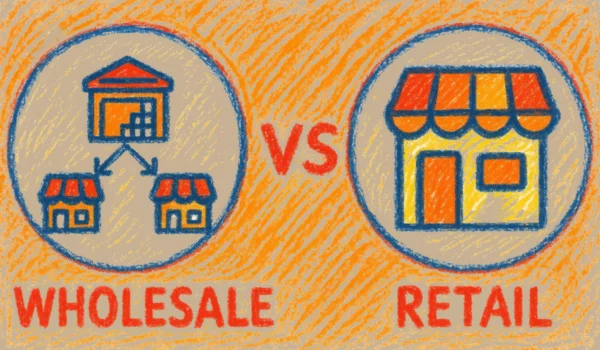
Wholesale and retail are two important parts of the supply chain. Both businesses involve selling products, but they operate differently in terms of customers, order size, pricing, investment, margins and daily operations.
A wholesaler generally purchases products in larger quantities from manufacturers or distributors and sells them to retailers or other businesses. A retailer, on the other hand, usually purchases products from wholesalers, distributors or manufacturers and sells them directly to final customers.
For someone planning to start a business in India, understanding the difference between wholesale and retail is important before investing money. The right model depends on factors such as available capital, target customers, location, product category and the level of involvement you want in day-to-day sales.
What Is a Wholesale Business?
A wholesale business involves buying products in bulk and selling them in larger quantities to businesses rather than individual consumers.
For example, a wholesaler may purchase packaged food, stationery, garments or electrical products in bulk and supply them to several retail shops.
The typical supply chain can look like:
Manufacturer → Wholesaler → Retailer → Customer
Wholesale businesses usually depend on high sales volume rather than selling individual units at a higher price.
Examples of Wholesale Businesses
Common wholesale categories in India include:
- FMCG products
- Grocery and food products
- Garments
- Footwear
- Electronics accessories
- Stationery
- Electrical products
- Hardware
- Packaging materials
- Beauty and personal-care products
- Agricultural products
Some wholesalers specialise in one category, while others maintain a broad product range.
What Is a Retail Business?
A retail business sells products directly to consumers for personal use.
A retailer may purchase products from wholesalers, distributors or manufacturers and sell them in a physical shop, through an online store or through other sales channels.
The common supply chain is:
Manufacturer → Distributor/Wholesaler → Retailer → Customer
Retailers generally sell smaller quantities than wholesalers and may earn a higher margin per individual product.
Examples of Retail Businesses
Popular retail businesses include:
- Grocery stores
- Clothing shops
- Footwear stores
- Electronics shops
- Mobile accessory stores
- Cosmetic stores
- Hardware shops
- Furniture stores
- Pharmacies
- Home-decor stores
- Online stores
Wholesale vs Retail: Key Differences
| Factor | Wholesale Business | Retail Business |
| Main customer | Retailers and businesses | Final consumers |
| Order size | Usually large | Usually small |
| Product price | Lower per unit | Higher per unit |
| Sales volume | High-volume orders | Frequent individual sales |
| Location | Warehouse or commercial area | Customer-facing location |
| Customer base | Fewer but larger accounts | Larger number of customers |
| Inventory | Usually large | Depends on store size |
| Marketing | Business relationships and sales teams | Local marketing and customer experience |
| Credit | Business credit may be common | Mostly immediate payment |
| Daily operations | Stock and order management | Sales and customer service |
The exact model can vary by industry. Some businesses operate as both wholesalers and retailers.
Wholesale vs Retail Profit Margin
One of the most common questions is which business has a higher profit margin.
There is no universal margin for either model.
Profit margins depend on:
- Product category
- Brand
- Purchase price
- Competition
- Location
- Sales volume
- Discounts
- Operating expenses
- Customer type
- Inventory turnover
A wholesaler generally works with a lower margin per unit because products are sold in bulk.
A retailer may sell individual units at a higher selling price, but the retailer also has additional expenses such as shop rent, salaries, electricity, display costs and customer acquisition.
For example, assume a product reaches a wholesaler at ₹100.
The wholesaler may sell it to a retailer at ₹105 or ₹110 depending on the commercial arrangement. The retailer may then sell the product to the customer at a higher price.
This does not mean the retailer automatically earns more profit. The retailer may have substantially higher operating expenses.
Therefore, compare net profit, not just the percentage margin on the product.
Wholesale Business Investment
Wholesale businesses can require substantial working capital because inventory is generally purchased in larger quantities.
Major expenses can include:
- Initial inventory
- Warehouse rent
- Security deposit
- Delivery vehicle
- Staff
- Billing and inventory software
- Packaging
- Loading and unloading
- Transportation
- Business registrations
- Working capital
The warehouse does not necessarily need to be located in a premium retail area. This can help reduce property costs compared with some customer-facing retail businesses.
However, wholesalers may need more money locked into inventory and receivables.
Retail Business Investment
Retail investment depends heavily on the type and location of the store.
Major expenses may include:
- Shop deposit
- Monthly rent
- Interior work
- Display shelves
- Signage
- Initial stock
- Billing system
- Staff
- Electricity
- Marketing
- Licences and registrations
- Working capital
A small neighbourhood store can be started on a much smaller scale than a large showroom.
However, a retail business in a high-footfall location may require considerable spending on rent and interiors.
Working Capital: Wholesale vs Retail
Working capital is important in both models but works differently.
Wholesale
A wholesaler may purchase large quantities and provide credit to retailers.
This means money can remain tied up in:
- Inventory
- Retailer receivables
- Security deposits
- Transportation
If retailers delay payments, the wholesaler may face difficulty paying suppliers.
Retail
Retailers generally receive payment when the customer purchases the product.
This can create faster cash conversion, although the retailer still needs money for inventory, rent, salaries and other expenses.
Online retailers may have different payment cycles depending on the marketplace or payment system they use.
Customer Acquisition
Wholesale and retail businesses also differ in how customers are acquired.
Wholesale Customer Acquisition
Wholesalers generally need to build relationships with:
- Retail shops
- Dealers
- Institutional buyers
- Restaurants
- Hotels
- Other businesses
- Small distributors
Sales representatives may visit businesses regularly and collect orders.
Retail Customer Acquisition
Retailers generally focus on:
- Store location
- Product availability
- Pricing
- Customer service
- Local advertising
- Online visibility
- Repeat customers
- Offers and promotions
For a retail business, the customer experience can have a direct effect on repeat sales.
Inventory Management
Inventory management is critical in both businesses.
A wholesaler may carry hundreds or thousands of units of a product because customers purchase in bulk.
A retailer may maintain a wider variety of products but fewer units of each item.
Both should monitor:
- Fast-moving products
- Slow-moving products
- Damaged goods
- Expiry dates
- Stock turnover
- Purchase costs
- Selling prices
- Unsold inventory
Overstocking can block capital, while understocking can result in lost sales.
Advantages of Wholesale Business
A wholesale model can offer several advantages:
Higher Order Sizes
A single retailer can purchase a significant quantity, reducing the need to process many small transactions.
Repeat Business
Successful wholesalers can develop long-term relationships with retailers and other business customers.
Lower Customer-Facing Costs
A warehouse generally does not need the same level of display and customer-facing infrastructure as a retail store.
Scope for Territory Expansion
Once a strong retailer network is established, wholesalers can expand into nearby markets.
Disadvantages of Wholesale Business
Wholesale also has challenges:
- High working-capital requirements
- Dependence on retailer payments
- Lower margin per unit
- Storage requirements
- Transportation expenses
- Competition from other wholesalers
- Risk of excess inventory
- Dependence on major brands or suppliers
Advantages of Retail Business
Retail businesses have their own strengths.
Direct Customer Relationship
You interact directly with the final customer and can understand buying preferences.
Higher Selling Price Per Unit
Retailers generally sell individual products at consumer prices rather than wholesale rates.
Faster Payment
Many retail transactions are paid immediately, reducing receivable risk.
Multiple Product Options
Retailers can stock products from different brands based on customer demand.
Disadvantages of Retail Business
Retail businesses may face:
- Higher rent
- Customer acquisition costs
- Staff expenses
- Competition from nearby stores
- Online competition
- Lower sales during weak demand
- Higher customer-service requirements
Wholesale vs Retail: Which Has Better Profit Potential?
Neither model guarantees higher profits.
A wholesale business may generate significant revenue through large-volume orders, but margins can be relatively thin and working-capital requirements can be high.
A retail business may generate a higher margin per unit, but expenses such as rent, salaries, electricity, marketing and store maintenance can reduce the final profit.
The important calculation is:
Net Profit = Total Sales − Product Cost − Operating Expenses − Other Business Costs
A business with a lower gross margin can still generate strong net profits if it has high stock turnover and controlled expenses.
Which Business Should You Choose?
The decision should depend on your circumstances.
Wholesale May Suit You If:
- You have sufficient working capital.
- You can manage bulk inventory.
- You are comfortable dealing with businesses.
- You can build a retailer network.
- You have access to warehouse space.
- You understand the selected product market.
Retail May Suit You If:
- You prefer dealing directly with consumers.
- You have access to a suitable location.
- You can manage daily customer interactions.
- You want to start on a smaller scale.
- You understand local customer demand.
- You can manage store-level expenses.
You can also combine both models. For example, a business may sell products wholesale to local retailers while operating its own retail outlet or online store.
How to Decide Between Wholesale and Retail
Before making a decision, compare these five factors:
- Available Capital
Calculate how much money you can invest without putting pressure on your personal finances.
- Product Category
Some products are naturally suited to bulk distribution, while others depend heavily on customer-facing retail sales.
- Local Demand
Study how many retailers and consumers are present in your target market.
- Operating Costs
Estimate rent, staff, transportation, electricity, marketing and other recurring expenses.
- Cash Flow
Do not focus only on expected sales. Calculate how quickly money will return after purchasing inventory.
Final Thoughts
Wholesale and retail businesses serve different roles in the supply chain. Wholesale focuses on bulk sales to businesses, while retail focuses on selling products directly to consumers.
Wholesale can be suitable for entrepreneurs who can manage larger inventories, working capital and business relationships. Retail can be suitable for those who prefer direct customer interaction and have access to a suitable market or location.
Before choosing either model, compare the expected sales volume, gross margin, operating expenses, inventory requirements and cash-flow cycle. The model that looks more profitable on paper is not necessarily the one that will generate better net returns for your specific market.