When buying a house, flat, plot or other immovable property, checking the seller’s ownership documents is not enough. A buyer should also check whether the property has any registered mortgage, charge, sale, lease or other registered transaction that may affect the title.
An Encumbrance Certificate (EC) is one of the documents commonly used for this purpose.
An EC is obtained from the relevant registration authority and provides information from the registration records for a specified property and period. However, an EC should not be treated as a complete guarantee that a property has a clear and marketable title.
The exact application process, format, period covered and online availability vary between states.
What Is an Encumbrance Certificate?
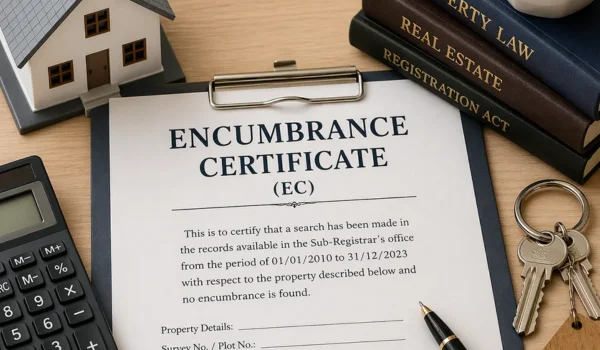
An Encumbrance Certificate is a certificate or record issued by the competent registration authority after searching its available registration records for a specified property and period.
An encumbrance generally refers to a legal or financial burden or claim affecting property.
Depending on the records and state system, the search may reveal registered transactions such as:
- Sale
- Mortgage
- Release of mortgage
- Lease
- Gift
- Partition
- Other registered dealings affecting the property
For example, the Tamil Nadu Registration Department provides an online EC application facility through its registration portal. Its official user manual states that citizens can apply online, make payment online and receive the processed document through their registered login.
Why Is an Encumbrance Certificate Important?
An EC can help a prospective buyer understand whether relevant registered transactions appear in the registration records for the property during the period searched.
This is important because a property may have been used as security for a loan or may have been involved in another registered transaction.
For example, suppose a seller wants to sell a house for ₹80 lakh.
Before completing the purchase, the buyer obtains an EC for the relevant period and finds a registered mortgage.
The buyer can then ask the seller to clarify:
- Whether the loan has been repaid
- Whether the mortgage has been released
- Whether a release document has been registered
- Whether any amount remains outstanding
This can help the buyer identify an issue before completing the transaction.
The Uttar Pradesh Registration Department also advises prospective buyers to verify the seller’s title and possession and inspect registration-office records concerning whether the property is free from encumbrances.
What Information Does an EC Show?
The information depends on the state and the type of certificate or search requested.
An EC may contain details relating to registered transactions, such as:
- Property description
- Survey or plot number
- Registration details
- Nature of transaction
- Names of parties
- Document number
- Registration date
- Period covered by the search
If no relevant registered transaction is found during the specified search period, the certificate may indicate that no such encumbrance was found in the records searched.
The exact wording and format differ between registration departments.
What Is a Non-Encumbrance Certificate?
You may also come across the term Non-Encumbrance Certificate (NEC).
Broadly, this refers to a certificate indicating that the relevant registration records searched do not show the specified encumbrances during the period covered.
For example, the Uttar Pradesh Stamp and Registration Department provides an online service specifically titled “Non-Encumbrance Certificate” and also provides an online system for applying for and obtaining the certificate.
The terminology is not completely uniform across India, so buyers should check what the local registration authority calls the relevant document.
What Is a Positive and Negative EC?
People sometimes use informal expressions such as:
Nil or Negative EC
This generally means that no relevant registered encumbrance was found in the records searched for the specified period.
Positive EC
This generally means that one or more registered transactions or encumbrances appear in the search.
A positive EC does not automatically mean that the property cannot be purchased.
For example, an EC may show a mortgage that has already been discharged, but the release may also need to be checked.
The underlying registered documents should therefore be examined rather than relying only on the words “positive” or “negative.”
How to Get an Encumbrance Certificate
The process depends on the state.
Generally, there are two possibilities:
- Online Application
Where the state registration department provides an online EC service, the applicant may need to:
- Visit the official registration department website.
- Select the EC or property-search service.
- Enter the required property details.
- Specify the search period.
- Pay the applicable fee.
- Submit the application.
- Track the application.
- Download or obtain the certificate after processing.
Tamil Nadu’s official EC manual, for example, provides an online application process in which the citizen submits the request and payment online and the Sub-Registrar processes the request before the document is made available through the registered account.
- Apply at the Sub-Registrar Office
Where online service is unavailable or where a particular search requires an office application, the applicant can approach the relevant Sub-Registrar Office (SRO).
The application generally requires enough information to identify the property and the period for which the search is required.
Documents and Information Needed for an EC
The exact requirements vary, but you may need information such as:
- Property address
- Survey number
- Plot number
- Door number
- Village or locality
- Sub-Registrar Office
- Previous registration details
- Document number
- Registration year
- Applicant details
- Search period
Accurate property identification is important.
If the wrong survey number, property number or registration jurisdiction is entered, the search may not cover the property you actually intend to purchase.
How Many Years Should You Check?
There is no single nationwide rule requiring the same EC period for every property purchase.
The appropriate period can depend on:
- State requirements
- Nature of property
- Age of the property
- Previous title documents
- Lender requirements
- Legal due diligence
- Availability of historical records
A buyer should not simply assume that downloading an EC for a short period is sufficient.
If the property has a long ownership history, a property lawyer may recommend examining older registered documents and the complete chain of title.
EC vs Title Deed
An EC and title deed serve different purposes.
| Point | Encumbrance Certificate | Title Documents |
| Main purpose | Shows relevant registered transactions found in the searched records | Establish ownership and transfer history |
| Issued/created by | Registration authority based on records searched | Executed/registered as part of property transactions |
| Shows ownership by itself? | No | Helps establish title, subject to legal examination |
| Shows mortgages/registered transactions? | May show relevant registered transactions | Individual documents may contain the transaction creating the right |
| Complete title proof? | No | Requires examination of the complete title chain |
| Should buyer check it? | Yes | Yes |
An EC should therefore be treated as one part of property due diligence, not as a replacement for title verification.
Does an EC Prove That the Property Is Free From All Legal Problems?
No.
This is one of the most important points.
An EC is based on the registration records covered by the relevant search. It should not automatically be interpreted as proof that:
- Nobody else has a claim
- There is no litigation
- There are no tax dues
- There are no land-use violations
- There are no acquisition proceedings
- There is no family dispute
- There are no unregistered interests
- The seller has perfect title
Some rights, claims, disputes or liabilities may not appear in the EC.
Therefore, a buyer should conduct broader due diligence.
EC vs Property Title Search
A title search is generally broader than simply obtaining an EC.
A title search may involve examining:
- Previous sale deeds
- Gift deeds
- Partition deeds
- Release deeds
- Wills and succession documents
- Court records where relevant
- Revenue records
- Mutation records
- Development or authority records
- Encumbrance records
- Property tax records
- Approved plans and permissions
- Other documents affecting title
The exact scope depends on the property.
The Uttar Pradesh Registration Department specifically advises buyers to verify the seller’s title and possession and inspect the registration records relating to encumbrances before purchasing immovable property.
What If the EC Shows a Mortgage?
Do not ignore it.
First determine whether the mortgage is:
- Still active
- Already repaid
- Released but not properly reflected
- Connected to a previous owner
- Related to another property or incorrect property identification
Ask for relevant documents, such as:
- Loan closure letter
- No-dues certificate
- Mortgage release document
- Registered release deed, where applicable
- Bank confirmation
The buyer should ensure that the necessary release and title documentation is completed before or as part of the transaction, as advised by a property lawyer.
Can I Get an EC for an Under-Construction Property?
It depends on the nature of the property and the registration records available.
For an under-construction apartment, an EC may not provide all the information a buyer needs because the project’s title and development documents require separate examination.
A buyer should also check:
- Project registration under RERA, where applicable
- Land title
- Development agreement
- Approvals
- Sanctioned plans
- Builder’s authority to sell
- Project-related encumbrances
- Agreement for sale
An EC should therefore not be the only document checked before booking a property.
Is an EC Required for a Home Loan?
Banks and housing finance companies may ask for an EC or similar property search documents as part of their legal and technical due diligence.
However, requirements vary between lenders.
The lender may also conduct its own title search and ask for additional documents.
Therefore, obtaining an EC yourself does not necessarily replace the bank’s legal verification.
How Much Does an EC Cost?
There is no single fee applicable throughout India.
The cost can depend on:
- State
- Search period
- Number of years
- Online or offline application
- Type of certificate
- Number of documents/pages
- Applicable government fee
Check the official registration department of the state where the property is located for the current fee.
How Long Does It Take to Get an EC?
There is no uniform processing time across India.
Some states provide online applications, while processing may still involve verification by the relevant Sub-Registrar Office.
For example, Tamil Nadu’s official EC manual states that an online application and payment are followed by processing by the Sub-Registrar, after which the document is made available through the applicant’s registered login.
The actual processing time can therefore vary depending on the state, records and application.
Common Mistakes When Checking an EC
Avoid these mistakes:
- Checking the EC for the wrong property
- Searching only a very short period without legal advice
- Assuming a nil EC guarantees clear title
- Ignoring a mortgage entry
- Not checking previous sale deeds
- Relying only on the seller’s copy
- Not verifying survey or plot numbers
- Ignoring court or revenue records
- Assuming all claims appear in registration records
- Buying property without independent title verification
Frequently Asked Questions
Is an Encumbrance Certificate mandatory for buying property?
There is no single rule making the same EC requirement applicable to every property transaction across India. However, obtaining and examining an EC is an important part of property due diligence.
Does an EC prove ownership?
No. An EC is not a substitute for title documents. It provides information from the relevant registration records for the searched property and period.
What does a nil EC mean?
Generally, it means that no relevant registered encumbrance was found in the records searched for the specified period. It does not guarantee that there are no other legal claims or title problems.
Can I get an EC online?
Yes, in states that provide online EC services. The exact process varies. Tamil Nadu, for example, provides an online EC application system through its registration portal.
Can an EC show a bank loan?
A registered mortgage or other relevant registered transaction may appear in the EC, depending on the records searched and the applicable registration system.
How far back should an EC be taken?
There is no universal period for every property. The appropriate search period should be determined based on the property’s title history, state practice, lender requirements and legal due diligence.
Is EC the same as a title search?
No. A title search is generally broader and involves examining the chain of ownership and other records affecting the property’s title.
Conclusion
An Encumbrance Certificate is an important property-due-diligence document because it can reveal relevant registered transactions affecting a property during the period covered by the search.
However, an EC should not be treated as a guarantee of clear title.
Before buying property, a buyer should ideally examine the EC, complete chain of title, previous registered documents, revenue records, possession, applicable approvals and relevant litigation or other records.
The exact EC application procedure, fees and terminology vary between states, so use the official registration department of the state where the property is located. Some state portals provide online EC applications, while others may require or support applications through the concerned Sub-Registrar Office.