Real estate is a popular choice for investors who want both regular income and long-term wealth creation. Traditionally, people bought a flat, shop, office or other property and earned rent from tenants.
Today, there is another option: a Real Estate Investment Trust (REIT).
A REIT allows investors to participate in income-generating real estate without directly buying and managing a physical property. SEBI explains that REITs are pooled investment vehicles that own real-estate assets and are listed and traded on stock exchanges.
This creates an interesting comparison:
REIT vs Rental Property — which is better for regular income?
There is no universal winner. Rental property gives you direct ownership and greater control, while REITs generally offer easier entry, diversification and liquidity.
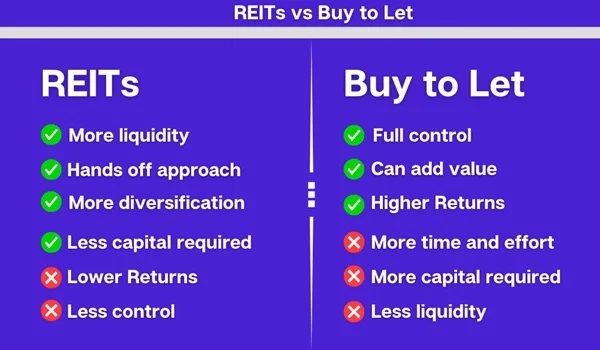
Quick Comparison
| Factor | REIT | Rental Property |
| Investment | Financial asset | Physical property |
| Minimum Capital | Generally much lower | Usually much higher |
| Regular Income | Distributions | Rent |
| Liquidity | Relatively high because units are listed | Low |
| Management | Professional REIT manager | Owner’s responsibility |
| Diversification | Usually multiple properties/assets | Usually one/few properties |
| Tenant Management | Handled by REIT structure | Owner handles it |
| Vacancy Risk | Portfolio-level | Directly affects owner |
| Price Volatility | Market-linked | Property market-linked |
| Leverage | Possible at REIT level | Owner can use home/property loan |
| Control | Low | High |
| Transaction Costs | Brokerage/market costs | Stamp duty, registration, brokerage etc. |
| Best For | Passive real-estate exposure | Direct ownership and control |
What Is a REIT?
A Real Estate Investment Trust pools investors’ money and invests in income-generating real estate.
Instead of buying an entire commercial building, an investor buys REIT units.
SEBI describes REITs as similar in structure to pooled investment vehicles, with a trust owning real estate on behalf of unit holders and a management company managing the portfolio. REIT units are listed and traded on stock exchanges.
The underlying properties can include assets such as:
- Office buildings
- Commercial complexes
- Warehouses
- Retail properties
- Other qualifying income-producing real estate
The exact assets depend on the particular REIT.
How Does a REIT Generate Income?
A REIT generally earns money from its underlying properties through sources such as:
- Rent
- Lease income
- Other property-related income
The income generated by the portfolio can then be distributed to unit holders, subject to the applicable REIT regulations and structure.
SEBI regulations require at least 90% of a REIT’s net distributable cash flows to be distributed to unit holders, with distributions required at least once every six months.
This is one reason REITs are often considered for income-oriented portfolios.
What Is Rental Property Investment?
Rental-property investment means buying a physical property and leasing it to tenants.
Examples include:
- Residential flats
- Independent houses
- Shops
- Offices
- Warehouses
- Commercial buildings
The investor receives rent directly from the tenant.
For example:
Property purchase → Tenant agreement → Monthly rent → Property expenses → Net rental income
The owner also benefits if the property appreciates in value and is later sold at a higher price.
REIT vs Rental Property for Regular Income
Both can generate recurring income, but the experience is very different.
REIT Income
With a REIT, distributions are generally made periodically according to the REIT’s distribution policy and applicable regulations.
The investor does not need to personally:
- Find tenants
- Negotiate leases
- Repair plumbing
- Maintain the building
- Collect rent
- Deal with tenant disputes
The REIT structure handles property management.
Rental Property Income
The property owner receives rent directly.
This can provide predictable monthly cash flow when the property is occupied.
However, the owner’s income can fall to zero during a vacancy unless other arrangements or multiple properties provide alternative income.
Example
Suppose you own a property generating:
₹40,000 monthly rent
Annual gross rent:
₹40,000 × 12 = ₹4.8 lakh
But this is not your final income.
You may need to pay for:
- Property maintenance
- Repairs
- Property tax
- Insurance
- Brokerage
- Society charges
- Vacancy periods
- Property management
So actual net rental income can be much lower than the headline rent.
REIT vs Rental Property: Investment Required
This is one of the biggest differences.
REIT
You do not need to purchase an entire building.
You buy units of a listed REIT through the market, making the capital requirement much lower than directly purchasing commercial real estate.
SEBI identifies low ticket size as one of the advantages of REITs and notes that listed units can be bought and sold through stock exchanges.
Rental Property
Physical property can require a large upfront amount.
Suppose a commercial property costs:
₹1 crore
Even with financing, the investor may need a substantial amount for:
- Down payment
- Stamp duty
- Registration
- Brokerage
- Interior work
- Repairs
- Initial vacancy
This makes direct property investment difficult for many smaller investors.
REIT vs Rental Property for Liquidity
Winner: REIT
REIT units are listed securities and can generally be bought and sold through the stock exchange.
A property is much harder to sell quickly.
Selling a physical property can involve:
- Finding a buyer
- Negotiation
- Property valuation
- Documentation
- Brokerage
- Stamp duty/registration issues for the buyer
- Significant time
A property may take weeks or months to sell, depending on the market.
REITs therefore have a major advantage for investors who value flexibility.
REIT vs Rental Property for Control
Winner: Rental Property
When you own the property directly, you decide:
- Which tenant to select
- Rent negotiation
- Renovation
- Property improvements
- Lease terms
- Sale timing
- Financing
With a REIT, you are a unit holder rather than the direct property manager.
You benefit from the portfolio but have much less individual control over specific properties.
REIT vs Rental Property for Diversification
Winner: REIT
Suppose you buy one ₹1 crore shop.
A large part of your wealth may be concentrated in one:
- Building
- Location
- Tenant
- Property type
If the tenant leaves, your income can be severely affected.
A REIT may own multiple properties across different locations and/or asset segments.
SEBI describes diversification and professional management as important features of the REIT structure.
This can reduce the impact of a problem with one individual property, although it does not eliminate investment risk.
REIT vs Rental Property: Vacancy Risk
Rental property has direct vacancy risk.
Suppose your property earns:
₹50,000/month
A tenant leaves and it takes four months to find another tenant.
Lost gross rent:
₹50,000 × 4 = ₹2 lakh
You may still have property-related expenses during the vacancy.
With a diversified REIT, individual tenant vacancies can be spread across a larger property portfolio.
However, REIT investors can still face reduced distributions if occupancy falls, tenants default, rents weaken or operating costs increase.
REIT vs Rental Property: Tenant Management
Winner: REIT
A direct property owner may have to deal with:
- Tenant selection
- Rent collection
- Lease renewal
- Maintenance complaints
- Repairs
- Vacating tenants
- Property management
In a REIT, these responsibilities are handled through the professional management structure.
This makes REITs particularly attractive to investors who want passive real-estate exposure.
REIT vs Rental Property for Returns
This comparison needs care because there are two different sources of return.
Rental Property
Total return can come from:
Rental Income + Property Appreciation
REIT
Total return can come from:
Distributions + Change in REIT Unit Price
A property can appreciate substantially over a long period, but REIT units can also appreciate when the underlying portfolio grows and market conditions are favourable.
Neither return is guaranteed.
Example
Suppose a ₹1 crore property produces:
₹5 lakh annual gross rent
That’s a gross rental yield of:
₹5 lakh ÷ ₹1 crore × 100 = 5%
Now imagine a REIT investment of ₹10 lakh produces an average annual distribution of ₹50,000.
That also represents:
₹50,000 ÷ ₹10 lakh × 100 = 5%
But the investments are not equivalent.
The property owner has:
- One physical asset
- Direct tenant exposure
- Maintenance responsibility
- Low liquidity
The REIT investor has:
- Listed units
- Portfolio diversification
- Professional management
- Market-price volatility
This is why yield alone should not determine the decision.
REIT vs Rental Property for Capital Appreciation
Both can appreciate, but the mechanism is different.
Rental Property
Property values may rise because of:
- Location development
- Infrastructure
- Demand
- Population growth
- Rental growth
- Commercial development
REIT
REIT unit prices can rise because of:
- Higher rental income
- Property appreciation
- Portfolio expansion
- Lower vacancy
- Interest-rate movements
- Investor demand
REIT prices can also fall even if the underlying properties remain fundamentally strong because REIT units trade on the stock market.
REIT vs Rental Property and Leverage
Rental property has an advantage for direct leverage.
A buyer can potentially use a property loan to acquire an asset worth much more than their available cash.
For example, someone may invest:
₹30 lakh own money + ₹70 lakh loan
to purchase a ₹1 crore property.
This can magnify gains if the property performs well.
But leverage also magnifies losses and adds:
- Interest expense
- EMI obligations
- Cash-flow pressure
- Default risk
REIT investors generally do not take a personal property loan to buy individual REIT units.
REIT vs Rental Property: Maintenance
Winner: REIT
Direct property ownership can involve:
- Repairs
- Painting
- Plumbing
- Electrical work
- Structural maintenance
- Tenant-related maintenance
In a REIT, these responsibilities are part of the operating structure of the underlying properties.
However, investors indirectly bear the economic impact of property operating expenses through the REIT’s cash flows.
REIT vs Rental Property: Taxation
Tax treatment is an important difference, and REIT taxation can be more complicated than ordinary rental income.
For direct rental property, rental income is generally taxed under the applicable rules for income from house property, with deductions and property-related provisions determined by the tax law.
For REITs, distributions can contain different components such as:
- Interest
- Dividend
- Rental income
- Other income
The Income Tax Department’s business-trust reporting framework separately identifies interest, rental/lease/letting income and dividend components distributed to unit holders.
Under the business-trust tax framework, income can retain its character in the hands of the unit holder rather than being treated as one single generic type of REIT income.
This means an investor should look at the tax breakup provided by the REIT, rather than simply applying one tax rate to the entire distribution.
REIT Capital Gains
REIT units are listed securities, so selling them can create capital gains.
The applicable tax depends on factors such as:
- Holding period
- Sale price
- Purchase price
- Applicable tax rules at the time
Tax legislation and rates can change, so investors should verify the rules applicable in the relevant tax year.
REIT vs Rental Property: Regular Income Stability
A common misconception is that both provide fixed monthly income.
Neither does.
Rental Property
Your rent depends on:
- Tenant occupancy
- Lease terms
- Rent increases
- Tenant payment behaviour
REIT
Your distribution depends on:
- Rental collections
- Occupancy
- Property expenses
- REIT cash flows
- Distribution policy
- Underlying asset performance
SEBI’s framework requires distributions from net distributable cash flows, but this does not mean a fixed income amount is guaranteed every month.
REIT vs Rental Property During Economic Downturns
During weak economic conditions:
Rental Property Risks
- Tenant vacancies
- Lower rents
- Longer leasing periods
- Property-price declines
REIT Risks
- Falling unit prices
- Lower distributions
- Higher financing costs
- Market volatility
- Property-sector weakness
A REIT may fall significantly in market price even when rental income remains relatively stable.
This can be uncomfortable for investors who are used to physical property valuations changing less visibly.
REIT vs Rental Property: Which Is Better for Retirees?
For a retiree looking for relatively passive real-estate exposure, REITs may be more convenient because the investment is liquid and professionally managed.
But someone who already owns a fully paid-off rental property with a reliable tenant may prefer direct rent because it provides a familiar cash-flow structure.
A retiree should also consider:
- Need for liquidity
- Tax situation
- Emergency cash requirements
- Risk tolerance
- Existing property exposure
REIT vs Rental Property: Which Is Better for Beginners?
REIT is generally easier to manage.
You do not need to:
- Search for tenants
- Buy property
- Negotiate leases
- Repair the building
- Manage maintenance
However, REITs are market-linked investments, so investors need to be comfortable seeing their unit price fluctuate.
A beginner who wants direct control over a physical asset may still prefer property, provided they can handle the much larger capital requirement.
REIT vs Rental Property: Which Is Better for Wealth Creation?
This depends on the investor.
REIT May Be Better When:
- Capital is limited
- You want diversification
- You prefer passive investing
- You want liquidity
- You do not want tenant management
Rental Property May Be Better When:
- You have substantial capital
- You understand the local property market
- You want direct control
- You are comfortable managing tenants
- You can tolerate low liquidity
- You have a strong property opportunity
REIT vs Rental Property: Example With ₹50 Lakh
Suppose you have ₹50 lakh to invest.
Option A: Rental Property
You may use the money as:
- Full payment for a smaller property
- Down payment for a larger property
You receive direct rent.
But you may also have:
- Loan interest
- Maintenance
- Vacancy risk
- Transaction costs
Option B: REIT
You can invest the ₹50 lakh across one or multiple listed REITs, depending on the available options and your portfolio strategy.
You gain:
- Diversification
- Market liquidity
- Professional management
- Regular distributions
But you also face:
- Market-price volatility
- REIT-specific risks
- Distribution variability
The decision therefore depends on whether you value control or convenience more.
REIT vs Rental Property: Advantages and Disadvantages
REIT Advantages
- Lower entry capital
- Listed and relatively liquid
- Diversified property exposure
- Professional management
- No direct tenant management
- Regular distributions are part of the structure
- Easy portfolio allocation
SEBI specifically identifies low ticket size, liquidity, transparency and regulation as advantages of REITs.
REIT Disadvantages
- Market-price volatility
- No guaranteed return
- Distribution can change
- Limited control over individual properties
- Tax treatment can involve multiple components
- Interest-rate and real-estate-sector risks
Rental Property Advantages
- Direct ownership
- Greater control
- Potential rental growth
- Potential property appreciation
- Possible use of leverage
- Tangible asset
Rental Property Disadvantages
- High capital requirement
- Low liquidity
- Maintenance responsibilities
- Tenant risk
- Vacancy risk
- Property-tax and transaction costs
- Concentration in one location/property
REIT vs Rental Property: Final Comparison
| Category | Better Choice |
| Lower initial investment | REIT |
| Liquidity | REIT |
| Diversification | REIT |
| Passive income | REIT |
| Professional management | REIT |
| Direct ownership | Rental Property |
| Control over tenant/property | Rental Property |
| Leverage | Rental Property |
| Tangible asset | Rental Property |
| Less maintenance work | REIT |
| Simple portfolio diversification | REIT |
| Potential for customised property strategy | Rental Property |
Final Verdict
For most investors whose primary goal is regular real-estate-linked income without the responsibility of owning and managing physical property, REITs can be the more convenient option.
They offer lower entry barriers, diversification, professional management and stock-exchange liquidity. SEBI also highlights these characteristics as key features of REITs.
Rental property may be better for investors who have substantial capital, strong knowledge of a local property market and a preference for direct ownership and control.
The biggest difference can be summarised simply:
REIT = Passive, diversified and liquid real-estate exposure
Rental Property = Direct ownership, control and potentially higher flexibility
For regular income, neither should be treated like a guaranteed fixed-income product. REIT distributions can vary, while rental income can stop during vacancies.
For an investor building a diversified portfolio, the choice does not necessarily have to be either/or. REITs can provide listed real-estate exposure, while physical property can serve a different purpose in a larger asset-allocation strategy.
FAQs
Is REIT better than rental property for monthly income?
REITs can be more convenient for passive real-estate income because they provide distributions without requiring the investor to manage tenants. Rental property can provide direct monthly rent but involves vacancies, maintenance and management responsibilities.
Is REIT income guaranteed?
No. REIT distributions are linked to the cash flows generated by the underlying assets. SEBI requires at least 90% of net distributable cash flows to be distributed, but the amount of cash flow itself can change.
Which requires more money: REIT or rental property?
Direct rental property generally requires substantially more capital because you are purchasing a physical asset. REITs allow investors to gain exposure to real estate through listed units without purchasing an entire property.
Can REITs lose money?
Yes. REIT units are listed securities and their market prices can rise or fall. Investors can also face changes in distributions due to property performance, occupancy, financing costs and other factors.
Is rent from property better than REIT distribution?
Not automatically. Property rent gives you direct cash flow and control, while REIT distributions provide more passive exposure and diversification. The better option depends on capital, risk, liquidity requirements and management preference.
Can I invest in REITs without buying a physical property?
Yes. Listed REIT units allow investors to participate in real-estate assets without directly purchasing and managing physical property. SEBI specifically describes REITs as a way to invest in real estate without owning physical property directly.