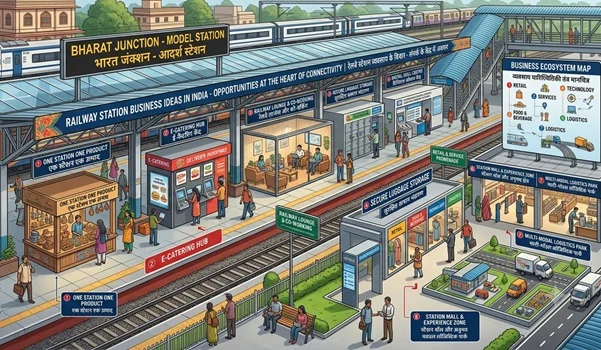
Railway stations are more than places where passengers board and leave trains. Busy stations also create demand for food, shopping, travel services, parking, advertising, passenger convenience and other commercial activities.
Indian Railways already has many types of commercial units at stations. According to the Indian Railways Year Book 2023–24, the network had 570 major static catering units, 9,308 minor static units such as stalls and trolleys, 1,742 Multi Purpose Stalls, 50 bookstalls, 34 miscellaneous/curio stalls and three exclusive chemist stalls at stations.
This makes railway stations an interesting business segment for entrepreneurs. However, most businesses operating inside railway premises require an authorised licence, tender, contract or permission. You cannot simply open a shop on a railway platform.
Quick Overview
| Business Idea | Main Customers | Business Model |
| Food Stall | Passengers | Railway tender/licence |
| Tea & Snacks Stall | Passengers & staff | Stall/trolley |
| Food Plaza | Passengers | Tender/auction |
| Fast Food Unit | Passengers | Tender/auction |
| Book & Magazine Stall | Passengers | Licensed stall |
| Multi Purpose Stall | Passengers | Railway allotment |
| Parking | Passengers & visitors | Contract/tender |
| Advertising | Brands & businesses | Commercial contract |
| Parcel/Courier Services | Passengers & businesses | Service-based |
| Travel Services | Passengers | Authorised service |
| Cloakroom/Passenger Services | Travellers | Contract/service |
| Hotel/Guest House Near Station | Travellers | Private business |
- Railway Station Food Stall
A food stall is one of the most obvious business opportunities at a busy railway station.
Passengers often need quick meals, snacks and beverages before boarding or during a train change. Railway catering rules provide for different types of catering units, including stalls, trolleys, refreshment rooms and other static units.
Depending on the station and unit, the available opportunity may be offered through a tender or other authorised allotment process.
Products can include:
- Packaged food
- Snacks
- Tea and coffee
- Breakfast items
- Regional food
- Bottled beverages
- Ready-to-eat products
Food businesses must also follow applicable food-safety and railway requirements. Indian Railways states that FSSAI certification from designated food-safety officers is mandatory for catering units.
- Tea and Snacks Business
A small tea and snacks operation can be suitable for stations with regular passenger movement.
The advantage of this model is its focus on quick-service products rather than a large restaurant setup.
However, the business must operate through an authorised railway stall, trolley or other permitted unit. Railway catering policy has provisions for minor static units such as catering stalls, milk stalls and trolleys.
- Railway Station Food Plaza
A food plaza is a larger commercial opportunity compared with a basic stall.
IRCTC describes food plazas as establishments designed to provide multiple cuisines under one roof, generally with a common kitchen.
Recent government e-procurement listings also show tenders for setting up and operating food plazas at railway stations.
This type of business may suit an entrepreneur or company with greater operating experience and financial capacity.
- Fast Food Unit
Fast food units focus on food that can be prepared and served quickly.
IRCTC has invited tenders for setting up and managing fast-food units at railway stations, showing that this is an established commercial category rather than simply a private shop opportunity.
Popular concepts may include:
- Sandwiches
- South Indian food
- Snacks
- Packaged meals
- Quick-service beverages
- Local food items
The exact menu and operating conditions depend on the tender and location.
- Multi Purpose Stall
A Multi Purpose Stall (MPS) can be another interesting railway business opportunity.
These stalls are designed to provide passengers with commonly required products and services. Indian Railways reported 1,742 Multi Purpose Stalls in operation during 2023–24.
The products allowed at a particular stall depend on the applicable railway policy and licence conditions.
- Book and Magazine Stall
Books, magazines, newspapers and travel-reading material can have demand at busy stations.
Railway stations have historically included bookstalls as part of their commercial passenger services. Indian Railways reported 50 bookstalls in its 2023–24 statistics.
This business can work particularly well where passengers have waiting time before trains.
- Railway Station Parking Business
Parking can be another opportunity at major stations.
Large stations receive passengers who arrive by:
- Cars
- Two-wheelers
- Auto-rickshaws
- Taxis
- Private vehicles
Instead of treating this as a normal private parking business, entrepreneurs need to look for the relevant railway parking contract or tender.
The contract may specify parking charges, operating hours, security arrangements, maintenance and other conditions.
- Railway Station Advertising Business
Railway stations provide valuable advertising space because of their large passenger footfall.
Possible advertising formats can include:
- Digital screens
- Display boards
- Hoardings
- Platform advertising
- Branding spaces
- Station-area displays
Advertising opportunities are generally controlled by railway authorities or authorised agencies. Businesses interested in this area should check current commercial tenders and licensing conditions.
- Parcel and Courier-Related Business
Passengers and businesses regularly need to move luggage, documents, parcels and other permitted goods.
This creates opportunities around parcel handling, logistics and courier services, particularly near stations with high passenger and commercial activity.
However, railway parcel operations and private courier operations are different. Entrepreneurs should clearly understand whether the proposed activity requires a railway contract, commercial agreement or other permission.
- Travel and Passenger Service Business
Travel-related services can also benefit from railway passenger traffic.
Depending on the location and applicable permissions, opportunities may include:
- Taxi services
- Local transport
- Tour packages
- Hotel booking assistance
- Travel assistance
- Tourist transportation
IRCTC itself has an established tourism and hospitality ecosystem, so businesses entering this segment should understand the relevant authorisation and partnership requirements.
- Chemist or Pharmacy Outlet
Passengers may sometimes need basic medicines and health-related products during travel.
Indian Railways reported three exclusive chemist stalls in its 2023–24 statistics.
This is a highly regulated category, so entrepreneurs should not assume that a normal pharmacy can automatically operate inside a railway station. Appropriate railway allotment and pharmacy-related legal requirements must be satisfied.
- Hotel or Guest House Near a Railway Station
You do not necessarily need to operate inside a railway station to benefit from railway passenger traffic.
A hotel, lodge, hostel or budget accommodation business near a busy railway station can target:
- Train passengers
- Families
- Business travellers
- Railway employees and visitors
- Tourists
- Passengers with long waiting times
This model can offer more independence because it is generally a private commercial property rather than a railway-station licence business.
How to Start a Railway Station Business
Starting a railway-related business requires more than selecting a good idea.
Step 1: Select the Business Category
First decide whether you want to operate:
- A food business
- Retail stall
- Parking facility
- Advertising service
- Passenger service
- Logistics business
- Accommodation near the station
Step 2: Identify the Relevant Railway Authority
Different activities can involve different railway departments, divisions or organisations.
For catering-related opportunities, IRCTC and zonal railway structures are particularly relevant. Railway Board information also lists specific policies and documents for catering units, bookstalls, Multi Purpose Stalls and other commercial activities.
Step 3: Check Current Tenders
Many opportunities are awarded through competitive tendering.
For example, IRCTC tender documents state that Food Plaza and Fast Food Unit licences are awarded through an open tender process, with technically qualified bidders proceeding to the financial stage.
Therefore, entrepreneurs should regularly check official railway and government e-procurement portals.
Step 4: Read the Complete Tender Document
Do not decide based only on the tender title.
Check:
- Eligibility
- Licence period
- EMD
- Security deposit
- Licence fee
- Permitted products
- Space available
- Operating conditions
- Maintenance requirements
- Food-safety requirements
- GST and other applicable taxes
- Penalties and cancellation conditions
The actual financial requirement can vary substantially from one location and tender to another.
How Much Investment Is Required?
There is no single investment amount for a railway station business.
A small authorised stall may require considerably less capital than a food plaza, while parking, advertising and other contracts can have completely different financial structures.
For example, recent IRCTC tender listings show different EMD amounts and financial conditions for different food-related opportunities. One food-plaza tender listed an EMD of ₹3 lakh, while a fast-food-unit tender listed ₹1 lakh. These figures are specific to those individual tenders and should not be treated as a standard investment requirement.
What Makes a Railway Station Business Profitable?
The biggest factors are usually:
- Passenger footfall
- Location of the unit
- Type of business
- Competition
- Licence and operating cost
- Product pricing
- Operating hours
- Staffing
- Product quality
- Waste and inventory management
A business at a high-footfall station may have a very different revenue potential from the same business at a small station.
Therefore, it is better to calculate profitability for each individual tender and location rather than relying on generic online claims about railway business profits.
Important Rules to Remember
If you want to start a business inside a railway station, remember:
- You generally cannot occupy railway space without authorisation.
- Check the relevant tender or allotment process.
- Read the licence conditions carefully.
- Follow railway pricing and service rules where applicable.
- Food businesses must meet applicable food-safety requirements.
- Maintain proper billing and cashless-payment requirements where applicable.
- Do not sell products that are prohibited under the licence.
- Keep the allotted area clean and operational.
- Renew or extend permissions only according to the applicable contract.
Indian Railways has specifically highlighted requirements such as cashless transactions, printed bills, MRP compliance and food-safety controls for catering units.
Best Railway Station Business Ideas: Which One Should You Choose?
There is no single best option for everyone.
For a small entrepreneur: tea/snacks, permitted retail or a small passenger-service opportunity may be more practical.
For an experienced food operator: a fast-food unit or food plaza can be considered where a suitable tender is available.
For a company: advertising, larger catering operations, parking or facility-management contracts may offer broader opportunities.
For someone who wants to avoid railway premises: a hotel, restaurant, parking facility or travel-service business near a busy railway station can be considered as a private business.
Final Thoughts
Railway stations offer a wide range of business opportunities because they bring together large passenger traffic, food demand, retail requirements, transportation needs and commercial advertising opportunities.
However, railway business is different from opening a normal shop. Tender rules, licences, contracts and railway policies are important, particularly for businesses operating inside station premises.
The safest approach is to identify the business category first, find the relevant official tender or allotment notice, calculate the complete cost, and only then decide whether the opportunity makes financial sense.
FAQs
Can anyone open a shop inside an Indian railway station?
No. Railway premises are controlled property, and commercial activities generally require the relevant authorisation, licence, allotment or contract.
Which railway station business is best for beginners?
Small authorised food, beverage or retail opportunities may be easier to understand than large food plazas or infrastructure contracts. The actual opportunity depends on available tenders and eligibility.
How can I get a railway station stall?
Look for relevant railway or IRCTC tender/allotment opportunities and carefully check the eligibility, financial requirements and licence conditions.
Is railway station food business profitable?
It can be, but profitability depends on passenger traffic, location, licence cost, product margins, competition and operating expenses.
Can I start a railway business without a tender?
It depends on the specific activity and location. Many commercial opportunities inside railway premises are allotted through authorised processes, including competitive tendering.
Where can I find railway business opportunities?
Check official Indian Railways, IRCTC and government e-procurement sources for current tenders and commercial opportunities. IRCTC also maintains information on empanelment and tender-related activities.