Cryptocurrency exchanges are used to buy, sell and store digital assets, but keeping crypto on an exchange involves an additional risk: what happens if the exchange stops operating?
The outcome depends on why the exchange shuts down and how the closure is handled. An exchange may announce an orderly withdrawal period, temporarily suspend withdrawals because of a security incident, or become insolvent and enter a legal or bankruptcy process.
Recent events show why this distinction matters. For example, DigiFinex announced in September 2026 that it was discontinuing relevant services for users in India and gave affected users a deadline to withdraw their assets.
What Happens to Your Crypto When an Exchange Shuts Down?
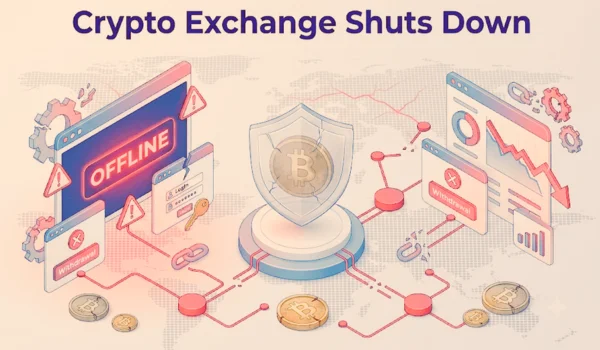
Your crypto does not automatically disappear when an exchange shuts down. However, your ability to access or withdraw it can be affected.
The possible outcomes include:
- The exchange allows users to withdraw their crypto before a deadline.
- Withdrawals are temporarily suspended.
- Trading stops but withdrawals remain available.
- The exchange converts or transfers assets under a wind-down arrangement.
- Customer assets become subject to a legal or insolvency process.
- Users may have to submit a claim to recover their assets.
The exact process depends on the exchange, the reason for the shutdown, applicable laws and how customer assets are held.
Why Can Crypto Withdrawals Be Frozen?
An exchange may suspend withdrawals for several reasons, including:
Security Incident
A hack or suspected compromise can lead an exchange to temporarily stop withdrawals while it investigates and secures its systems.
For example, in September 2026, Bitget temporarily suspended withdrawals following a major security incident and said it would cover the affected loss from its reserves.
Liquidity Problems
If an exchange does not have sufficient assets or liquidity to meet withdrawal requests, it may restrict withdrawals.
Regulatory Action
An exchange may stop offering services in a particular country because of regulatory or compliance requirements.
Insolvency
If an exchange becomes insolvent, access to customer assets can become significantly more complicated. Recovery may depend on the exchange’s legal structure, asset ownership arrangements and applicable insolvency proceedings.
What Happens During an Orderly Exchange Shutdown?
An orderly shutdown is generally easier for users to deal with because the exchange provides instructions and a deadline.
The exchange may:
- Stop accepting new users.
- Disable deposits.
- Stop trading.
- Keep withdrawals open temporarily.
- Announce a final withdrawal deadline.
- Begin closing accounts after the deadline.
For example, DigiFinex announced that deposits and trading for Indian users would stop from September 10, 2026, while withdrawals were scheduled to remain available until December 31, 2026.
If an exchange provides a withdrawal deadline, users should not wait until the final day.
What Happens If the Exchange Goes Bankrupt?
Bankruptcy or insolvency can be more complicated than a normal shutdown.
The exchange may have obligations to customers, creditors, employees and other parties. How customer crypto is treated can depend on the platform’s legal structure, its terms of service, custody arrangements and the applicable insolvency law.
Users may be required to:
- Verify their identity.
- Confirm their account balance.
- Submit a claim.
- Provide transaction records.
- Wait for the legal or administrative process.
- Receive assets or proceeds according to the applicable process.
There is no universal rule that guarantees every customer will immediately receive all crypto held on an insolvent exchange.
Do You Still Own Your Crypto on an Exchange?
This depends on the legal and contractual structure of the exchange and how the assets are held.
From a practical perspective, when crypto is held in an exchange account, the user generally does not control the private keys directly. The exchange controls the wallets used to hold and transfer the assets.
This creates custody risk in addition to the market risk of cryptocurrency itself.
The commonly used principle is:
If you do not control the private keys, you do not have direct control over the on-chain assets.
This does not by itself determine the legal ownership of the assets, but it highlights the difference between holding crypto through an exchange and holding it in a self-custody wallet.
What Happens to Crypto in a Self-Custody Wallet?
If you hold crypto in a properly controlled self-custody wallet, an exchange shutdown does not directly freeze those assets because the exchange does not control the wallet.
However, self-custody creates different risks.
You are responsible for:
- Private keys
- Seed phrase
- Wallet security
- Backup
- Transaction approvals
- Avoiding phishing and scams
If the seed phrase or private key is permanently lost, access to the assets may also be lost.
What Should You Do If Your Crypto Exchange Announces a Shutdown?
If withdrawals are still available, consider taking action promptly.
- Read the Official Announcement
Check the exchange’s official website, app and email communications for:
- Withdrawal deadline
- Supported networks
- Supported assets
- Minimum withdrawal amounts
- Fees
- KYC requirements
- Account closure procedure
Do not rely only on social-media posts or messages forwarded by other users.
- Check Your Account Balance
Record your crypto and fiat balances before initiating withdrawals.
Download relevant:
- Transaction history
- Deposit records
- Withdrawal records
- Account statements
- Tax reports
These records can become important if a dispute or claim arises.
- Withdraw to a Wallet or Another Available Platform
If withdrawals are open, transfer your assets to a wallet or another platform after checking the destination address and network carefully.
A wrong network or address can result in loss of funds.
- Check Network Compatibility
For tokens available on multiple blockchain networks, make sure the receiving wallet supports the exact network selected for the withdrawal.
- Keep Proof of Withdrawal
Save transaction IDs or blockchain transaction hashes after completing withdrawals.
These can help verify that a transaction was initiated and completed.
What If Withdrawals Are Already Suspended?
Do not assume that the suspension automatically means your crypto is permanently lost.
First, check the exchange’s official announcement to determine why withdrawals have been suspended.
Possible reasons include:
- Security investigation
- Maintenance
- Regulatory restrictions
- Liquidity problems
- Insolvency
- Technical problems
Keep records of your balance and all communication with the exchange.
If the issue develops into a dispute, the appropriate complaint or legal route will depend on the exchange, jurisdiction and circumstances. In India, crypto-exchange disputes are not automatically covered by the same investor-protection mechanisms that apply to SEBI-regulated securities intermediaries. A 2026 Delhi High Court matter involving BitBNS users also illustrates that disputes involving private crypto exchanges can raise private-law and commercial-remedy issues.
Can You Recover Crypto From a Closed Exchange?
Recovery is possible in some situations, but it is not guaranteed.
The outcome may depend on:
- Whether the exchange remains solvent
- Whether customer assets can be identified
- Whether assets are held separately
- The exchange’s terms and legal structure
- The jurisdiction involved
- Court or insolvency proceedings
- Whether the user submits the required claim correctly
An orderly shutdown with an open withdrawal window is very different from an exchange collapse in which withdrawals are frozen.
Does Exchange Shutdown Affect the Value of Your Crypto?
The shutdown of an exchange does not necessarily change the underlying blockchain balance of a cryptocurrency.
However, the market price of a token can be affected if a major exchange stops trading it or if users lose confidence in the platform or asset.
There can also be temporary liquidity problems if a particular token becomes difficult to trade or withdraw.
Therefore, access to crypto and the market value of crypto are two different issues.
What Happens to Your Crypto If an Exchange Is Banned in India?
A shutdown or withdrawal of services specifically for Indian users does not necessarily mean that the underlying cryptocurrency ceases to exist.
The exchange may instead stop providing services to Indian customers and give users a period to withdraw their assets.
For example, DigiFinex’s September 2026 announcement described an orderly withdrawal process for Indian users rather than an immediate disappearance of customer balances.
Users should follow the specific instructions and deadlines communicated by the platform.
Is Crypto Protected Like Money in a Bank Account?
Crypto held on an exchange should not automatically be treated as equivalent to money deposited in a bank.
The legal protections, custody arrangements and recovery mechanisms can differ significantly between crypto platforms and regulated banking products.
This is why users should understand the exchange’s terms, custody arrangements and applicable regulatory framework before keeping substantial amounts of crypto on a platform.
How to Reduce Exchange Shutdown Risk
You cannot completely eliminate exchange or custody risk, but you can reduce your exposure.
Consider:
- Keeping only the amount needed for trading on an exchange.
- Using reputable platforms and checking their regulatory/compliance status where relevant.
- Enabling strong account security and two-factor authentication.
- Keeping transaction records.
- Understanding withdrawal rules and fees.
- Learning how self-custody works before transferring significant assets.
- Never sharing private keys or seed phrases.
- Avoiding links and messages asking for emergency withdrawals or account verification.
SEBI’s general investor guidance also emphasizes understanding risks, preserving transaction records and dealing with appropriate regulated intermediaries for securities-market activities. These protections should not be assumed to apply automatically to crypto exchanges.
Exchange Shutdown vs Wallet Loss
An exchange shutdown and loss of a self-custody wallet involve different risks.
| Situation | Main Risk |
| Exchange operates normally | Exchange custody and operational risk |
| Exchange temporarily suspends withdrawals | Temporary loss of access |
| Exchange orderly shutdown | Need to withdraw before deadline |
| Exchange becomes insolvent | Recovery may depend on legal/insolvency process |
| Self-custody wallet | User controls access but bears key-management risk |
| Lost seed phrase | Access may become permanently unavailable |
Conclusion
When a crypto exchange shuts down, your assets do not automatically disappear, but access to them can become difficult or delayed. An orderly shutdown may give users a specific period to withdraw their crypto, while insolvency, hacking or regulatory action can result in frozen withdrawals and a more complicated recovery process.
The most important step is to monitor official exchange announcements and act before a stated withdrawal deadline. Users should also keep transaction records and understand the difference between exchange custody and self-custody.
For Indian users, it is particularly important to check the specific status and terms of the platform they use because crypto exchanges do not necessarily have the same investor-protection framework as SEBI-regulated securities intermediaries.